










Most content does not fail because it is poorly written, badly designed or uninteresting. It fails because it is used once.
A company publishes a thoughtful article, shares it on LinkedIn, sends one email and then moves on. A designer records a useful tutorial, uploads it to YouTube and immediately starts planning the next video. A podcast team spends days preparing an interview, yet most of the ideas inside that conversation never leave the original episode.
Artificial intelligence offers a different approach. Instead of treating every article, video, podcast or report as a finished object, it allows creative teams to treat strong source content as raw material for a larger publishing system.
But effective AI content repurposing is not the process of copying the same message into ten formats. It is the disciplined work of identifying the strongest ideas, adapting them to different audiences, rebuilding them for different platforms and maintaining quality across every version.
This guide explains how to repurpose content with AI using a practical workflow for 2026. It covers source selection, content extraction, platform adaptation, visual production, human review, distribution and performance analysis. It also includes reusable prompt templates and a complete example showing how one long-form article can become more than 30 distinct content assets.
How to Repurpose Content With AI: The Quick Answer
To repurpose content with AI, begin with one valuable source asset, extract its central ideas, map those ideas to relevant channels and use AI to create channel-specific drafts. Then review every draft for accuracy, originality, brand voice and audience relevance before publishing.
A reliable AI content repurposing workflow follows this sequence:
- Select a strong source asset.
- Define the audience and business goal.
- Extract the core arguments, examples and supporting details.
- Create a content map for each platform.
- Generate platform-specific drafts.
- Create visual, audio and video assets.
- Review facts, tone, originality and brand consistency.
- Schedule content in a logical sequence.
- Measure performance by idea and format.
- Update the workflow based on what performs best.
The important distinction is that AI should accelerate the transformation of an idea, not replace the judgment behind it.
One strong idea can support an entire campaign. One weak idea simply becomes weak content at scale.
What Is AI Content Repurposing?
AI content repurposing is the process of using artificial intelligence to transform an existing piece of content into new formats, angles and platform-specific assets.
The original source may be:
- a long-form blog article;
- a research report;
- a webinar or conference presentation;
- a podcast episode;
- a YouTube video;
- a customer interview;
- a case study;
- a product demonstration;
- a newsletter;
- or a collection of expert notes.
From that source, a team may create LinkedIn posts, email sequences, short videos, carousels, visual quotes, FAQs, sales materials, updated website sections and new articles.
However, content repurposing is not the same as content duplication.
Content duplication repeats the same asset
Duplication happens when the same paragraph is copied from a blog article into LinkedIn, Instagram and an email without meaningful adaptation. The words may be technically correct, but the content often feels misplaced because every platform has a different reading environment.
Content repurposing rebuilds the idea
Repurposing begins with the idea rather than the original wording. The creator asks:
- What is the most useful insight?
- Which audience needs it?
- What format will make it easiest to understand?
- What context must be added or removed?
- What should the reader do next?
A detailed article may become a practical checklist for LinkedIn, a visual framework for Instagram, a demonstration for YouTube and a short opinion-led newsletter. The source is the same, but each asset performs a different job.
This distinction reflects a broader principle behind effective AI workflows: better results rarely come from adding more platforms. They come from building a clearer system around the work, with defined goals, reliable inputs and consistent human review.
Why Content Repurposing Matters in 2026
The pressure to publish has increased, but attention has become more fragmented. A potential customer may discover a brand through search, LinkedIn, a short video, an email recommendation or an image shared by someone else.
That does not mean every business must create completely new content for every channel. It means valuable ideas need more than one route to the audience.
Different people prefer different formats
Some readers want a detailed guide. Others need a two-minute explanation. A visual learner may understand a concept through a diagram that felt abstract in a 2,000-word article. A decision-maker may only need five key points and a clear recommendation.
Repurposing allows one body of knowledge to meet those different preferences without rebuilding the research from the beginning.
Strong content becomes more valuable over time
A useful article should not disappear from the publishing calendar after one week. It can be updated, expanded, challenged, visualized and connected to newer ideas.
This is particularly important for evergreen material such as workflows, design principles, frameworks, tutorials and tool comparisons. The strongest source content can become the foundation of a larger topic cluster rather than an isolated page.
AI reduces production friction
Before AI, content repurposing often required several specialists or many hours of manual rewriting. Today, AI can help teams identify themes, create first drafts, reorganize information, propose visual directions, generate scripts and compare alternative angles.
That speed is useful, but only when paired with editorial control. A faster production process does not automatically create stronger content. It merely gives the team more material to evaluate.
Repurposing creates a more coherent brand
When one original idea is intentionally adapted across multiple touchpoints, the audience begins to recognize what the brand knows and believes.
This is different from publishing unrelated posts simply to remain active. Repeated exposure to a clear idea can strengthen authority, provided each asset contributes something new.
How to Choose the Right Source Content
Not every existing asset deserves to be expanded into a full campaign. The quality of the repurposed content depends heavily on the quality of the source.
Before beginning, evaluate the source using five criteria.
1. Relevance
The topic should address a current problem, recurring question or meaningful interest within the target audience.
A source asset does not need to be new, but it must still be useful. An older guide can become valuable again when updated with new examples, current tools or a clearer framework.
2. Depth
A strong source contains more than a headline-level observation. It includes reasoning, steps, examples, contrasts, evidence or a distinctive point of view.
AI cannot extract 30 meaningful assets from three generic paragraphs without introducing repetition or filler.
3. Original value
The source should contain something that belongs to the creator: direct experience, tested methods, informed analysis, a case study, a useful framework or a clearly argued position.
Originality does not require inventing an entirely new topic. It requires adding a perspective that readers cannot obtain from a collection of interchangeable summaries.
4. Proven interest
Look at search impressions, reader questions, comments, saves, email replies, watch time and previous social performance. These signals can reveal which ideas deserve deeper investment.
A post that generated thoughtful questions may be a better repurposing candidate than a post with high reach but no meaningful engagement.
5. Strategic fit
The source should connect to a product, service, category or topic cluster the brand wants to strengthen.
For example, an article about content repurposing can support future DesignRise content about AI video tools, creative automation, social media design, visual content systems and editorial workflows.
A simple source-content scoring system
| Criterion | Question | Score |
|---|---|---|
| Audience relevance | Does this solve a real or recurring problem? | 1–5 |
| Depth | Does the source contain enough substance for several angles? | 1–5 |
| Originality | Does it include experience, analysis or a distinctive framework? | 1–5 |
| Existing demand | Have people searched for, shared or discussed this topic? | 1–5 |
| Business relevance | Does it support an important brand or commercial objective? | 1–5 |
Content scoring highly across all five areas is usually worth turning into a complete repurposing campaign.
The Complete AI Content Repurposing Workflow for 2026
The following workflow can be used by solo creators, design teams, agencies, marketers and editorial departments. The tools may change, but the logic of the system remains stable.
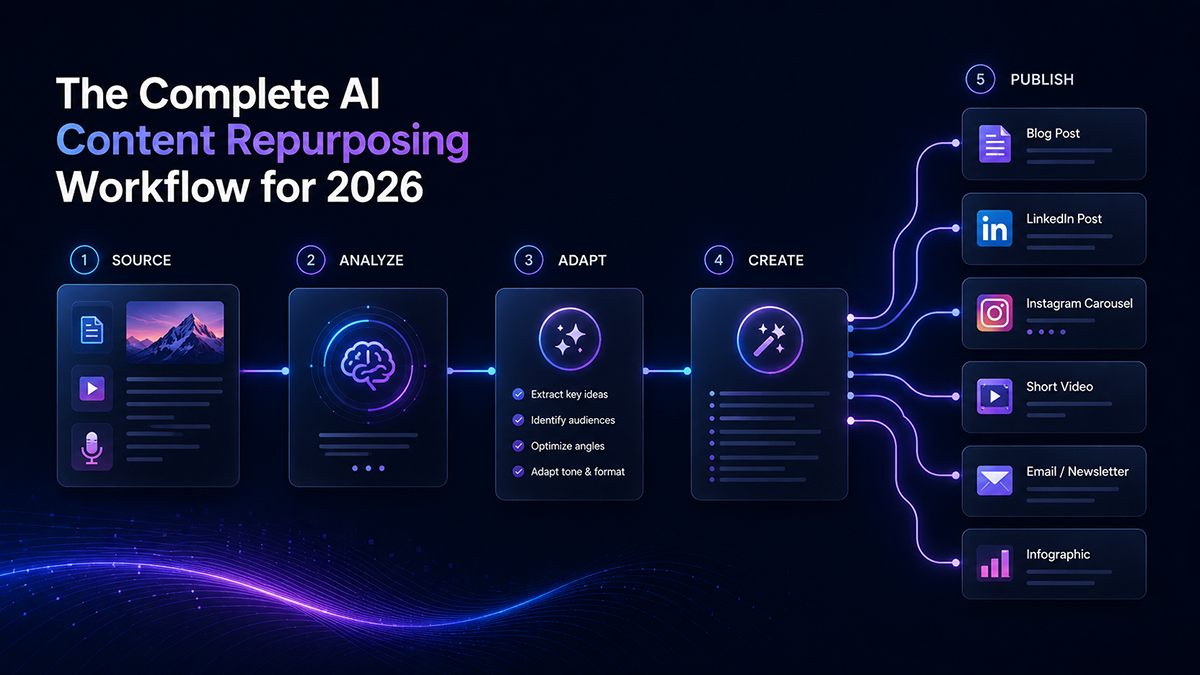
Step 1: Define the purpose before opening an AI tool
Begin by deciding what the repurposed content should achieve.
Possible goals include:
- attracting search traffic;
- building authority around a topic;
- increasing newsletter subscriptions;
- supporting a product launch;
- educating potential customers;
- generating qualified leads;
- reviving a high-value older article;
- or creating consistent social content.
Without a clear objective, AI often produces a large quantity of disconnected assets. A defined purpose gives the system a direction.
Step 2: Create a clean source document
Gather the complete source content in one place. Remove menus, advertisements, unrelated comments, broken formatting and repeated text before giving it to an AI model.
For a video or podcast, prepare a clean transcript. Add speaker names where relevant and correct obvious transcription errors, especially product names, people, technical terms and numbers.
The source document should also include context the AI cannot infer reliably:
- the intended audience;
- the main objective;
- the preferred tone;
- the brand position;
- claims that must not be changed;
- and topics that should be avoided.
Step 3: Extract the content intelligence
Before asking AI to produce posts, ask it to analyze the source.
The first output should be a structured editorial summary containing:
- the central argument;
- five to ten supporting ideas;
- important examples;
- useful quotations or memorable phrases;
- practical steps;
- questions the source answers;
- questions the source leaves unanswered;
- potential objections;
- and possible follow-up topics.
This step separates extraction from creation. It helps prevent the AI from immediately rewriting the source into generic promotional language.
Step 4: Build an idea hierarchy
Not every point deserves equal attention. Divide the extracted ideas into three levels:
- Core idea: the central argument that defines the campaign.
- Supporting ideas: explanations, steps, examples and contrasts.
- Micro-ideas: individual tips, observations, quotations, questions and visual moments.
The core idea may become the main article or video. Supporting ideas may become standalone posts. Micro-ideas may become Stories, short clips, graphics or email sections.
This hierarchy prevents the campaign from sounding as though every asset is repeating the same introductory message.
Step 5: Match ideas to channels
Choose formats based on the idea and the audience, not merely on what the AI can generate.
| Content Type | Best Use | Suitable Source Material |
|---|---|---|
| SEO article | Depth, search visibility and evergreen education | Complete framework or detailed tutorial |
| LinkedIn post | Professional insight, opinion and discussion | One strong argument or lesson |
| Instagram carousel | Visual education and saveable steps | Framework, checklist or before-and-after process |
| Short video | Demonstration, discovery and quick explanation | One problem, transformation or surprising insight |
| Email newsletter | Context, relationship and direct response | Editorial perspective plus practical advice |
| X thread | Condensed arguments and rapid idea progression | Numbered lessons, findings or mistakes |
| Pinterest graphic | Searchable visual discovery | Checklist, template, idea list or tutorial |
| FAQ section | Direct answers and search support | Recurring questions and objections |
This stage connects research, creative production and distribution within one clear system, helping the team move from a source idea to finished content without losing context, quality or brand consistency.
Step 6: Create a content repurposing map
A content map is a production plan showing what will be created, for whom and why.
Each row should include:
- the source idea;
- the target platform;
- the intended audience;
- the format;
- the angle;
- the call to action;
- the required visual;
- the publication date;
- and the review status.
At this stage, resist the temptation to create everything. A focused set of eight relevant assets is more valuable than 30 repetitive ones.
Step 7: Generate channel-specific drafts
Now AI can begin writing. Give it one asset at a time rather than requesting an entire campaign in a single prompt.
A good generation prompt should identify:
- the exact source idea;
- the audience;
- the platform;
- the desired length;
- the content goal;
- the tone;
- the structure;
- the required call to action;
- and any language to avoid.
Ask for two or three variations with genuinely different angles. Do not ask for minor wording changes. One version might be practical, another opinion-led and another built around a specific example.
Step 8: Create visual and video assets
Content repurposing becomes significantly more valuable when written ideas are translated into visual formats.
A long article can support:
- a process diagram;
- an Instagram carousel;
- a comparison chart;
- a quote card;
- a short animated explainer;
- a vertical video script;
- a before-and-after graphic;
- or a downloadable checklist.
Visual generation should follow the same brand system as the original article. Reuse typography, colors, image treatment, spacing principles and tone rather than generating a completely new visual identity for every post.
For more ideas about turning existing visuals into new creative assets, see Blend Images Using AI: 10 Creative Tips for Designers. Video-focused teams can also explore Top AI Tools for Motion Designers & Video Creators.
Step 9: Add human editorial review
No content should move directly from generation to publication.
The editor should verify:
- factual accuracy;
- whether the output reflects the source correctly;
- whether examples have been invented;
- whether the introduction is too generic;
- whether the tone fits the brand;
- whether the content adds anything useful;
- whether the call to action is appropriate;
- and whether the asset is meaningfully different from previous content.
AI is particularly likely to flatten strong writing into safe, predictable language. Restore specificity. Replace abstract phrases with concrete examples. Remove exaggerated claims. Change repetitive sentence structures. Add observations that could only come from someone who understands the subject.
Step 10: Publish in a sequence, not all at once
A repurposing campaign works best as a connected series.
For example:
- Publish the full article.
- Share one central insight on LinkedIn.
- Publish a carousel explaining the framework.
- Send a newsletter with a more personal editorial angle.
- Release a short video demonstrating one step.
- Share a practical checklist several days later.
- Return to the article with a new question or counterargument.
This sequence gives each asset room to perform and allows the audience to encounter the same topic through several useful entry points.
Step 11: Connect every asset to a useful next step
The call to action should match the content.
A practical carousel may lead to the complete article. A short video may lead to a downloadable checklist. A newsletter may invite a reply. A comparison post may lead to a relevant tool collection.
Not every asset needs to sell something. The next step may simply be reading a deeper explanation.
Step 12: Create a reusable workflow document
After completing the campaign, document what worked.
Save:
- successful prompts;
- brand instructions;
- editing checklists;
- visual templates;
- platform structures;
- approval rules;
- and naming conventions.
This turns content repurposing from an occasional experiment into a repeatable operating system. Instead of rebuilding the process for every article, video or podcast, the team gains a documented structure that can be refined with each new campaign.
How to Turn One Article Into 30 Content Assets
Consider a hypothetical 2,500-word article titled:
How to Build a More Efficient AI Design Workflow
The article includes a central argument, five workflow stages, three common mistakes, a tool-selection framework and a practical checklist.
Instead of publishing the article once, the team could build the following campaign.

Long-form assets
- The original SEO article.
- A condensed Medium version with a new introduction.
- A LinkedIn article focused on the professional implications.
- A newsletter featuring the author’s personal experience.
LinkedIn assets
- An opinion post: why more AI tools do not automatically improve a workflow.
- A five-step practical framework.
- A post describing the most common workflow mistake.
- A short case example showing the old and new process.
Instagram assets
- A seven-slide educational carousel.
- A “three mistakes” carousel.
- A quote graphic.
- A workflow diagram.
- A short Story sequence introducing the article.
- A question sticker asking followers about their biggest workflow problem.
Short-form video assets
- A 30-second explanation of the central argument.
- A 45-second demonstration of one workflow stage.
- A “stop doing this” video built around a common mistake.
- A before-and-after process comparison.
- A short answer to a frequently asked question.
Search and website assets
- An FAQ section added to the original article.
- A supporting article about choosing AI tools.
- A supporting article about preserving brand voice.
- An internal checklist page.
- A downloadable workflow template.
Email assets
- A launch email.
- A follow-up email focused on one mistake.
- A practical checklist email.
Additional micro-content
- A five-post X thread.
- A Pinterest infographic.
- A discussion prompt for an online community.
The purpose is not to publish 30 versions of the same paragraph. Each asset should isolate a different part of the source, use a format suited to the platform and create a clear reason to engage.
AI Content Repurposing Prompt Templates
The following prompts are designed as starting structures. Replace the bracketed sections with your own information and continue refining the output through feedback.
Prompt 1: Extract the strongest ideas
Analyze the source content below as an experienced editor. Identify the central argument, the five most valuable supporting ideas, the strongest examples, the most practical steps, recurring audience questions and any claims that require verification. Do not rewrite the article yet. Return a structured editorial brief and explain why each idea may be useful to the target audience.
Prompt 2: Create a repurposing map
Using the editorial brief below, create a content repurposing map for [target audience]. The business goal is [goal]. Recommend assets for LinkedIn, Instagram, email, short-form video and the website. Give every asset a distinct angle, intended outcome, format, hook and call to action. Avoid repeating the same argument across multiple platforms.
Prompt 3: Write a LinkedIn post
Turn the following source idea into a LinkedIn post for [audience]. Begin with a specific observation rather than a generic motivational hook. Explain one useful idea, include a practical example and finish with a thoughtful question. Keep the tone professional, direct and human. Avoid exaggerated claims, clichés and phrases such as “in today’s fast-paced world,” “game-changer” and “revolutionize.”
Prompt 4: Create an Instagram carousel
Transform the following framework into an eight-slide Instagram carousel. Slide 1 should communicate the problem clearly. Slides 2–7 should explain one step each using concise language. Slide 8 should provide a useful conclusion and invite the reader to view the complete guide. Include a headline and supporting text for every slide. Do not reduce the content to empty slogans.
Prompt 5: Create a short video script
Write a 45-second vertical video script based on the source idea below. Structure it as: problem, unexpected insight, practical explanation, example and final takeaway. Use natural spoken language and short sentences. Add suggested on-screen text and visual changes. Do not begin with “Did you know?”
Prompt 6: Adapt an article into an email
Turn the following article into an editorial email for existing subscribers. Do not summarize the entire article. Choose one strong idea, explain why it matters, add a useful example and lead naturally to the full guide. The email should feel like a thoughtful note from an expert, not an automated promotional message.
Prompt 7: Preserve brand voice
Review the draft against the brand voice guidelines below. Identify sentences that sound generic, exaggerated, repetitive or unlike the brand. Rewrite only those sections. Preserve the meaning and factual details. Explain the most important changes after the revised draft.
Prompt 8: Find new content opportunities
Analyze the source article and the audience questions below. Identify ten follow-up topics that deserve separate content. Divide them into beginner, intermediate and advanced topics. For each topic, propose a search-focused title, the user problem it addresses and how it connects back to the original article.
Choosing AI Tools for Each Stage
The most useful AI content repurposing system is rarely built around one tool. Different stages require different capabilities.
Research and source analysis
Use tools that can process long documents, organize notes, compare sources and identify patterns. The objective is not merely to summarize, but to build a reliable understanding of the source.
AI-enabled browsers can also help during the research stage by organizing webpages, extracting key information and supporting topic exploration. See Best AI Browsers in 2026: 10 Tools That Research, Summarize and Automate the Web for a dedicated comparison.
Writing and adaptation
Choose a language model that handles detailed instructions, long context and iterative editing. Consistency is often more important than generating the most creative first draft.
Visual production
Visual tools may be used to build backgrounds, diagrams, illustrative concepts, social graphics and campaign variations.
The workflow should always preserve visual consistency. The principle is similar to creating a repeatable brand system, as explained in AI Brand Identity Workflow: From Idea to Complete Visual Brand.
Product and ecommerce visuals
When repurposing product content, accuracy becomes especially important. Packaging, color, proportions and labels must remain faithful to the real product.
For a dedicated production process, read AI Product Photography Workflow: From Raw Product Photo to Marketplace-Ready Image.
Video and audio transformation
Video tools can identify useful clips, generate captions, remove silence, resize footage and create shorter platform-specific edits. Human review is still necessary because an automatically selected clip may lack context or distort the speaker’s meaning.
Automation and scheduling
Automation tools can transfer approved assets between documents, project boards, databases and publishing platforms.
Automate handoffs only after the workflow is stable. Automating a confused process makes the confusion faster.
Human Review, Accuracy and Brand Voice
The central risk of AI content repurposing is not that the content will be completely unreadable. It is that it will be acceptable, polished and forgettable.
Generic content is often grammatically correct. It may contain appropriate headings, smooth transitions and familiar advice. Yet it lacks the details that create trust.
Check every factual statement
AI may alter numbers, combine examples, attribute a conclusion to the wrong source or present an assumption as established fact.
Compare every claim with the original material. For high-stakes subjects, return to the primary source rather than relying on an AI summary.
Protect the meaning of quotations
Do not allow AI to invent quotations or rewrite a person’s words while presenting them as direct speech. If a quote is shortened, ensure that the original meaning remains intact.
Remove generic AI language
Watch for phrases that appear polished but add little substance:
- “in today’s rapidly evolving landscape”;
- “unlock the power of”;
- “take your content to the next level”;
- “seamlessly transform”;
- “revolutionize your strategy”;
- and “the possibilities are endless.”
Replace these phrases with specific information about what changes, who benefits and under which conditions.
Add human judgment
A strong editor asks questions that a generation prompt may not:
- Is this actually useful?
- Does this point deserve its own asset?
- What would an experienced reader challenge?
- What detail makes the argument credible?
- What should be removed rather than expanded?
Maintain visual consistency
Repeated content does not require repeated design, but the campaign should still feel related. Use a recognizable system of typography, color, layout and image direction.
The audience should be able to recognize the brand before reading the account name.
How to Measure Content Repurposing Performance
Do not evaluate the workflow only by counting how many assets were produced.
Production volume is an internal metric. Audience response and business impact are more important.
Measure the source asset
For the original article or video, track:
- search impressions;
- organic clicks;
- average engagement time;
- scroll depth;
- newsletter sign-ups;
- relevant conversions;
- and internal-link clicks.
Measure each format differently
A carousel may be valuable because people save it. A newsletter may be successful because readers reply. A LinkedIn post may generate professional conversations. A short video may introduce the brand to a new audience.
Do not force every platform into the same success metric.
Measure ideas, not only individual posts
If the same core idea performs well across several formats, it may deserve a deeper article, a tool collection, a case study or a recurring series.
If an idea consistently underperforms, changing the font or rewriting the first sentence may not solve the underlying problem.
Calculate content efficiency
Record the total time spent on:
- research;
- source production;
- AI generation;
- human editing;
- design;
- approval;
- and publishing.
The objective is not maximum automation. It is a better relationship between effort, quality and results.
Common AI Content Repurposing Mistakes
Mistake 1: Repurposing content that was weak from the beginning
AI can reorganize weak content, but it cannot create genuine authority from an empty source. Improve the original idea before multiplying it.
Mistake 2: Publishing the same wording everywhere
Every platform has different expectations. Adapt the argument, opening, length, examples and call to action.
Mistake 3: Asking for too many assets in one prompt
Large batch prompts often produce repetitive, shallow content. Generate one format at a time and review the result before moving forward.
Mistake 4: Allowing AI to choose every angle
AI can suggest angles, but the editor should decide which ideas matter to the audience and the brand.
Mistake 5: Removing all complexity
Not every idea should become a simplified list. Some subjects require nuance, context and careful explanation.
Mistake 6: Ignoring brand voice
A content campaign may be visually consistent yet editorially fragmented. Provide clear language guidelines and examples of previous writing.
Mistake 7: Automating publication before review
Automatic posting creates unnecessary risk when outputs contain factual errors, awkward phrasing or unsuitable visuals.
Mistake 8: Measuring only reach
Large reach does not always indicate useful content. Consider saves, replies, qualified visits, subscriptions and conversions.
Mistake 9: Forgetting internal links
Repurposed content should strengthen the wider website. Connect supporting articles to central guides and central guides to relevant collections, workflows and creative analysis.
Mistake 10: Never updating the original source
Questions and comments generated by the campaign may reveal missing sections in the original article. Use that feedback to improve the source page.
A 30-Day AI Content Repurposing Implementation Plan

Week 1: Build the foundation
- Select one high-value source asset.
- Define the audience and primary objective.
- Clean and organize the source.
- Create a brand voice document.
- Extract the core and supporting ideas.
Week 2: Create the campaign map
- Choose the most relevant channels.
- Assign one distinct angle to every asset.
- Create a publishing sequence.
- Prepare reusable prompt templates.
- Design the required visual templates.
Week 3: Produce and review
- Generate first drafts.
- Edit every asset manually.
- Check facts and quotations.
- Create supporting visuals and videos.
- Complete a final brand and quality review.
Week 4: Publish and learn
- Publish the original source asset.
- Release supporting content gradually.
- Track performance by platform and idea.
- Collect audience questions.
- Document improvements for the next campaign.
After one month, the goal is not simply to have more content. The goal is to have a documented workflow that can be repeated with less effort and stronger editorial control.
Frequently Asked Questions
What is the best way to repurpose content with AI?
The best approach is to begin with one valuable source, extract its strongest ideas, create a channel-specific content map and generate each asset separately. Every draft should then be reviewed for accuracy, originality, brand voice and audience relevance.
Can ChatGPT repurpose content?
A general-purpose language model can help summarize source material, identify themes, produce outlines, adapt writing for different platforms and create first drafts. It should not be trusted to publish content without human verification and editing.
What types of content can be repurposed?
Articles, podcasts, webinars, videos, interviews, reports, case studies, presentations, newsletters, research notes and product demonstrations can all become source material for new content.
How many assets should be created from one article?
There is no correct number. A detailed article may support five strong assets or more than 30. The right number depends on the depth of the source, the number of useful ideas and the relevance of each format.
How do you repurpose a blog post for social media?
Do not summarize the entire article in every post. Select one useful argument, step, example, mistake or question and rebuild it for the chosen platform. Link to the full article when readers would benefit from additional depth.
Can AI turn an article into a video?
AI can help convert an article into a script, storyboard, shot list, voiceover draft and visual plan. The final video still needs editorial judgment, pacing, visual direction and quality control.
Is AI-generated repurposed content bad for SEO?
The use of AI alone does not determine whether content is useful. Problems arise when pages are inaccurate, repetitive, shallow or created only to increase publishing volume. Search-focused content should answer real questions, demonstrate clear value and be reviewed by someone who understands the topic.
How can AI content avoid sounding repetitive?
Assign a different purpose and angle to every asset. Use separate examples, openings and calls to action. Ask AI to work from one supporting idea at a time rather than repeatedly summarizing the complete source.
Should content repurposing be fully automated?
Research organization, formatting, transcription, draft generation, file movement and scheduling may be partially automated. Fact-checking, editorial decisions, brand judgment and final approval should remain under human control.
Final Thoughts: Repurpose the Knowledge, Not Just the Words
The most effective AI content repurposing workflow does not begin with the question, “How many posts can we generate?”
It begins with a more demanding question:
How many genuinely useful ways can we help the audience understand this idea?
That shift changes everything. The article is no longer a disposable publishing task. It becomes a source of knowledge. A video is no longer a single upload. It becomes a collection of arguments, examples and visual moments. A podcast is no longer an hour of audio. It becomes an editorial archive that can support future articles, discussions and creative work.
AI makes this system faster, but speed is not the primary advantage. The greater advantage is continuity: research is used more completely, strong ideas remain visible for longer and every new asset can strengthen a larger body of work.
At DesignRise, the most valuable AI workflows are not built to remove people from the creative process. They are built to give designers, writers and creative teams more time for the decisions that require experience, taste and judgment.
A strong source idea deserves more than one publication. With a thoughtful workflow, it can become the beginning of an entire content ecosystem.
Discover more from DesignRise
Subscribe to get the latest posts sent to your email.