




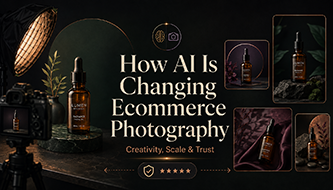
How AI is changing ecommerce photography is becoming one of the most important creative questions for online brands in 2026. Generative tools are transforming how product images are planned, produced and adapted, while raising new concerns about accuracy, authenticity and customer trust.
For most of its history, ecommerce photography followed a familiar sequence. A product arrived at a studio. A photographer arranged the lights. A stylist adjusted the scene. The team captured a limited number of angles, retouched the selected images and distributed the final files across product pages, advertisements and social media.
The photographs might remain in use for months. Sometimes they lasted for years.
Artificial intelligence is breaking that model apart.
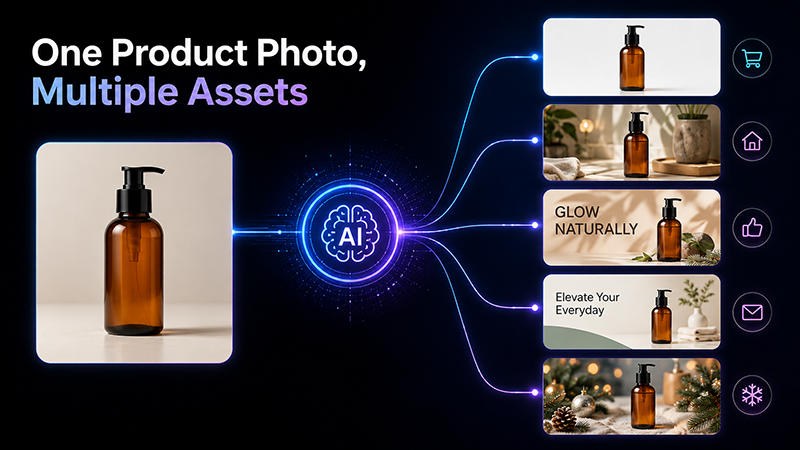
In 2026, a single product photograph can become the starting point for dozens of visual assets: a clean marketplace image, a seasonal advertisement, a lifestyle scene, a social media campaign, a localized version for another country and a short promotional video. Backgrounds can be replaced in seconds. Sets can be generated without being built. Products can be placed into environments that never physically existed.
This is often described as a faster way to produce product photos. That description is accurate, but incomplete.
AI is changing what ecommerce photography is. It is moving the field away from a fixed collection of finished photographs and toward a flexible visual system that can be continuously adapted, tested and expanded.
The opportunity is substantial. Small brands can create images that once required a studio, props, locations and a larger production budget. Established retailers can refresh thousands of product assets more quickly. Creative teams can explore campaign concepts before committing to a physical shoot.
But the same technology creates a difficult question: when an image is designed to sell a real object, how far can it move away from reality before it becomes misleading?
This is the central tension shaping AI ecommerce photography in 2026. The technology offers more creativity and scale than traditional product production could reasonably provide. At the same time, it places greater responsibility on brands to protect product accuracy, visual credibility and customer trust.
At DesignRise, we see this shift as more than a new editing trend. It is a change in how creative teams plan, produce and evaluate commercial imagery. The challenge is no longer simply generating an attractive visual. It is building a system that can scale without weakening the truth of the product.
How Is AI Changing Ecommerce Photography?
AI is changing ecommerce photography by making it faster and easier to produce, edit and adapt product images at scale. Brands can now remove backgrounds, build lifestyle scenes, generate campaign variations, adjust image formats and create new visual contexts from a small collection of original product photographs.
The most important changes are:
- product photography is becoming a continuous system rather than a one-time shoot;
- small businesses can access more professional-looking visual production;
- brands can create more image variations for different audiences and channels;
- creative testing can happen before expensive physical production;
- virtual models and synthetic environments are becoming part of ecommerce campaigns;
- photographers are moving toward creative direction, quality control and hybrid production;
- and product accuracy is becoming one of the most important measures of AI image quality.
The strongest use of AI is not to replace every real photograph. It is to expand what can be created from accurate, well-produced source material.
Traditional photography captures what was in front of the camera. AI-assisted photography can build an entire visual campaign around what the camera captured.
Ecommerce Photography Is No Longer a Single Photoshoot
A traditional product shoot is an event. It has a date, a location, a budget, a shot list and a deadline. Once the set is dismantled and the team leaves, producing additional images usually requires another round of planning.
That model works well when a brand needs a limited number of carefully directed photographs. It becomes less efficient when the same product must appear across dozens of channels, formats, campaigns and markets.
An ecommerce team may need:
- a white-background image for the primary product listing;
- several detail photographs;
- a lifestyle scene for the product page;
- a vertical version for Stories or Reels;
- a wide banner for the website;
- a seasonal version for a holiday campaign;
- a clean visual for email;
- and multiple advertisement variations for testing.
AI allows the original photography to remain active after the shoot ends. Instead of treating each photograph as a finished asset, a brand can treat it as a verified source from which additional visual material is created.
This changes the economics of production, but it also changes the creative mindset. The key question is no longer only, “Which photographs must we capture today?” It becomes, “Which reliable source images will give us the greatest creative range later?”
From Capturing Images to Building Visual Systems
The phrase product photography once referred mainly to the act of photographing a product. In an AI-assisted workflow, the process extends far beyond the camera.
A modern visual system may include:
- high-quality source photographs;
- accurate masks and transparent product cutouts;
- approved lighting and shadow styles;
- brand-specific background directions;
- reusable prompts and reference images;
- platform-specific crops and dimensions;
- human quality-control rules;
- and a record of which assets are real, edited or generated.
Large ecommerce catalogs make this systems approach especially important. Generating one impressive image is relatively easy. Creating 500 images that feel like part of the same campaign, preserve every product detail and remain visually consistent is far more difficult.
Consistency does not come from entering the same prompt repeatedly. Generative systems can interpret identical instructions differently from one output to the next. A scalable workflow therefore needs stable references, approved templates and human review.
For a practical production process, read the DesignRise guide AI Product Photography Workflow: From Raw Product Photo to Marketplace-Ready Image. It explains how a source photo moves through cleanup, background creation, refinement, quality control and final export.
One Product Can Now Live in Hundreds of Visual Worlds
AI gives product photography an extraordinary new creative range.
A bottle of perfume can appear on a marble surface in one campaign, beside dark volcanic rock in another and inside a soft botanical scene for a spring launch. A chair can be shown in a Scandinavian apartment, a warm Mediterranean home or a minimal architectural studio. A pair of headphones can move from a clean catalog image to a cinematic night scene without the product being transported anywhere.
These are not merely background replacements. The strongest results consider:
- the direction and softness of the light;
- the relationship between the product and the surface;
- the scale of nearby objects;
- the angle of the camera;
- the depth of field;
- the visual language of the brand;
- and the reason the product belongs in that environment.
Tools from major commerce and creative platforms already reflect this shift. Amazon Ads’ image-generation features use product information to help advertisers create brand-themed and lifestyle imagery. Google Product Studio allows merchants to create custom scenes, remove backgrounds and improve existing product images using generative AI.
Adobe Firefly also supports generated backgrounds for product photography, while Photoshop’s generative tools allow designers to extend scenes, remove distracting objects and build new compositions around an existing product.
The result is a form of visual flexibility that traditional production rarely offered. A brand can explore several campaign territories before deciding which one deserves further investment.
More visual options do not automatically produce better creative work
Unlimited variation can create its own problem. When every imaginable scene is available, creative direction becomes more important, not less.
A product should not be placed in a rainforest, a luxury hotel or a futuristic laboratory simply because AI can create the scene. The environment still needs to communicate something relevant about the product, the audience and the brand.
Without a clear idea, generative ecommerce photography can become a collection of attractive but interchangeable images. The visuals may look polished while saying very little.
Professional Product Imagery Is Becoming More Accessible
Traditional ecommerce photography is resource-intensive. Even a simple production may require a camera, lighting equipment, a suitable space, styling materials, retouching software and someone who knows how to use them.
For smaller businesses, those requirements often lead to one of two outcomes: the launch is delayed, or the product is published with images that do not reflect its quality.
AI lowers some of those barriers.
Shopify, for example, now offers AI-powered media generation within its file-editing environment. Merchants can modify product images and create more professional visual assets without moving through a traditional design workflow.
This accessibility matters for:
- independent makers;
- small ecommerce stores;
- early-stage brands;
- marketplace sellers;
- local businesses launching online;
- and teams that need to test demand before funding a major campaign.
However, accessible production should not be confused with effortless production. AI can make image creation easier, but a strong result still depends on taste, product knowledge and careful review.
A small brand may no longer need a physical set for every social image. It still needs to understand how its product should be positioned, which details customers need to see and which visual choices make the brand recognizable.
To understand how AI is changing ecommerce photography at scale, it is necessary to look beyond individual image generation. The larger shift is happening in the way brands manage complete catalogs, campaigns and visual systems.
The Real Advantage of AI Is Scale
The most visible AI demonstrations usually focus on one transformation: a basic product photo becomes a dramatic lifestyle image.
For ecommerce businesses, the more important story is scale.
Retailers do not manage one image. They manage catalogs containing many products, variations, colors, sizes and seasonal updates. Every asset may need to appear in several dimensions and across multiple channels.
AI can accelerate work that once consumed a large part of the production schedule:
- background removal;
- image cleanup;
- canvas extension;
- format adaptation;
- basic relighting;
- resolution improvement;
- shadow generation;
- and the creation of visual variations.
This allows creative teams to spend less time reconstructing the same asset for every placement.
Scale changes what a campaign can be
In the traditional model, a campaign was often built around a small set of hero visuals. Those images had to work across many contexts because producing alternatives was expensive.
AI makes it possible to create more specific assets:
- different scenes for different audience segments;
- localized backgrounds for different regions;
- visuals for narrow advertising placements;
- seasonal updates without a new physical shoot;
- and multiple creative directions for testing.
This does not mean every customer should see a completely different reality. It means brands can make the presentation more relevant while keeping the product itself consistent.
The catalog-consistency problem
Scale also exposes weaknesses in generative tools.
A single image may look convincing in isolation while a full product grid reveals:
- inconsistent camera heights;
- changing product proportions;
- different shadow directions;
- uncontrolled color temperatures;
- uneven background tones;
- and gradual changes to logos or packaging.
These inconsistencies are sometimes called visual drift. They matter because ecommerce catalogs depend on comparison. When every image follows a different visual logic, the store becomes harder to scan and the brand feels less reliable.
The solution is not simply a better prompt. It is a controlled production system with reference images, repeatable compositions and final human approval.
Ecommerce Photography Is Becoming More Experimental
Physical production requires commitment. A brand selects a concept, books a team, builds a set and hopes the idea works when everything comes together.
Generative tools make creative exploration cheaper and faster. Before constructing a physical set, a team can test:
- different color environments;
- lighting directions;
- surface materials;
- prop combinations;
- seasonal concepts;
- camera framing;
- and visual moods.
This is one of the most valuable uses of AI for professional photographers and art directors. The technology can function as a visual sketchbook.
Instead of describing a concept through a written mood board alone, the team can generate early scene studies and ask more precise questions:
- Does the product disappear against this background?
- Does the lighting feel too cold?
- Does the visual look premium or artificial?
- Does the environment support the product story?
- Can the concept expand into video, social media and packaging?
Some experiments will remain entirely synthetic. Others will become references for a real photoshoot. The distinction matters less than whether the exploration improves the final creative decision.
The Rise of Synthetic Models and Virtual Photoshoots
Fashion and beauty ecommerce are moving beyond generated backgrounds. Brands can now create on-model images, change models, visualize garments on different bodies and build campaign-style scenes without assembling a traditional cast and production team for every variation.
Virtual photoshoots can help brands explore:
- different model appearances;
- regional campaign variations;
- new poses and environments;
- additional clothing combinations;
- and faster content for products with short selling cycles.
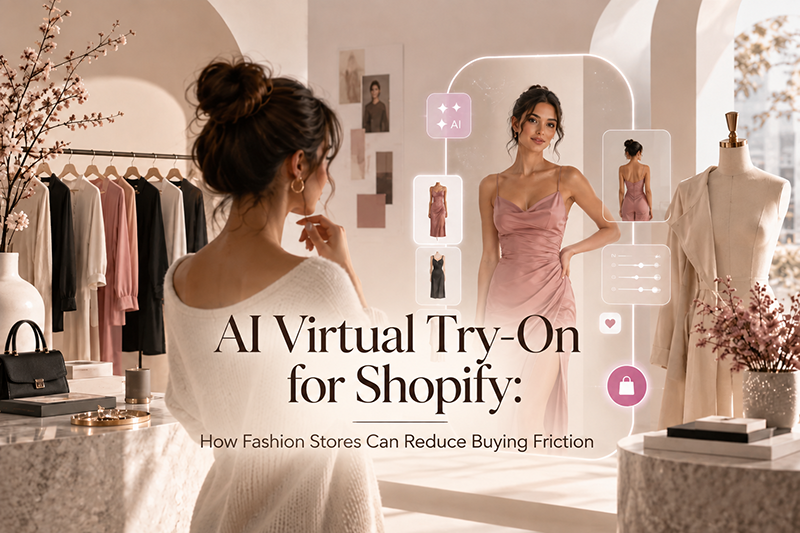
Virtual try-on technology is also becoming part of the shopping experience. Instead of viewing a garment only on a retailer-selected model, shoppers can increasingly see an approximation of how an item may look in a more personal context.
This can make ecommerce imagery more useful, but it introduces additional creative and ethical questions.
Representation cannot be reduced to a dropdown menu
AI makes it technically easier to generate models with different ages, body types and appearances. That does not automatically make a campaign genuinely inclusive.
Representation requires judgment about context, styling, cultural meaning and the way people are portrayed. A campaign assembled entirely through demographic prompts can still feel shallow or stereotypical.
Garment behavior must remain believable
Apparel is particularly difficult because the image must communicate:
- how the fabric drapes;
- where the garment fits closely or loosely;
- how long it appears on the body;
- how patterns align around seams;
- and how the material responds to movement and light.
An attractive generated image may still create the wrong expectation about fit. That makes human quality control essential, especially when the visual appears on a product page rather than in a conceptual campaign.
This is where the DesignRise perspective becomes especially important: creative freedom is valuable only when it remains connected to product truth. In ecommerce, visual innovation should expand the story around the object—not quietly redesign the object itself.
Product Accuracy Is the New Creative Constraint
In editorial illustration, an invented detail may be part of the idea. In ecommerce photography, an invented detail can become a false promise.
A product image is not only decoration. It is evidence. Customers use it to judge what they are buying.
That makes accuracy the defining creative constraint of AI product photography.
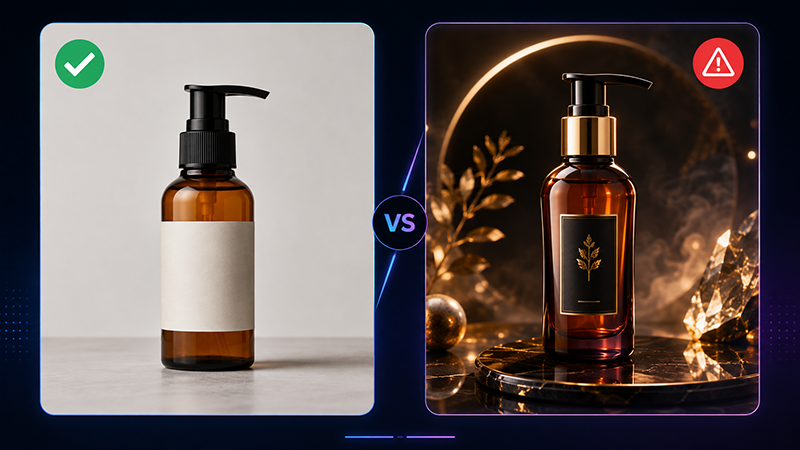
What must remain accurate?
- Shape: The outline and proportions must match the real product.
- Color: The displayed color should remain close to what the customer will receive.
- Material: Metal, glass, leather, fabric and plastic must respond to light in believable ways.
- Packaging: Labels, caps, closures and printed elements must remain correct.
- Text: Product names, measurements and instructions cannot be rewritten by the model.
- Quantity: The image must not imply that additional items are included.
- Scale: The surrounding scene should not make the product appear larger or smaller than it is.
- Function: The image must not suggest a capability the product does not have.
Google Merchant Center’s image guidance states that product imagery should accurately display the product. Its misrepresentation policies also restrict promotions that present a business or product in a way that is not accurate, realistic and truthful.
These principles existed before generative AI. AI simply makes them more urgent because incorrect details can now be created with extraordinary visual confidence.
Photorealism is not the same as truth
A generated image may have convincing shadows, beautiful lighting and realistic textures while still showing the wrong product.
This is one of the most dangerous qualities of generative ecommerce imagery. Obvious visual mistakes are easy to reject. Subtle changes can pass through production because the image looks professional at first glance.
For that reason, ecommerce teams should evaluate AI visuals at two levels:
- Does this look convincing?
- Does this accurately represent the product?
The second question matters more.
The Trust Problem: When a Beautiful Image Becomes Misleading
Ecommerce has always depended on a gap between image and object. The customer sees a photograph on a screen but receives a physical product later.
Good product photography narrows that gap. It helps the shopper understand the object before purchasing it.
Bad AI photography can widen it.
The trust problem appears when a generated image improves the appearance of the product by changing something the customer would consider important.
Examples include:
- a cosmetic bottle appearing larger than it is;
- a fabric looking thicker or softer than the real material;
- a piece of jewelry appearing more reflective or detailed;
- food appearing to contain ingredients that are not included;
- a lamp illuminating a larger area than it can in reality;
- or product packaging displaying text that does not exist.
These changes may not be intentional. A model can generate them while trying to make the composition more visually coherent. The customer experiences the result, not the intention.
Trust is a commercial asset
Short-term visual performance should not be separated from long-term customer confidence.
An exaggerated image may attract attention. If the delivered product feels noticeably different, the brand may face:
- returns;
- negative reviews;
- customer-support complaints;
- platform-policy problems;
- and a gradual loss of credibility.
The best ecommerce image is not necessarily the most dramatic. It is the image that makes the product desirable without making it unrecognizable.
Conceptual advertising and product evidence are not the same
Brands should distinguish between three types of imagery:
- Catalog imagery should present the product as clearly and accurately as possible.
- Lifestyle imagery may create atmosphere, but the product should remain faithful to reality.
- Conceptual campaign imagery may use metaphor, fantasy or exaggeration, provided the creative intent is clear and does not misrepresent the item being sold.
Confusion occurs when a highly conceptual image is presented as straightforward evidence of the product.
Do AI Product Images Need to Be Disclosed?
There is no single universal answer that applies to every country, platform, image type and advertising context. Rules and platform practices continue to develop.
However, the direction is clear: platforms and regulators are paying greater attention to synthetic media, misleading representations and AI-generated advertising.
Meta has introduced labels for advertisements created or significantly edited with its generative AI tools. Google and other platforms also maintain policies requiring truthful product representation.
For ecommerce brands, disclosure should not be treated only as a legal checkbox. It is also a design and trust decision.
When disclosure deserves serious consideration
A brand should consider clear disclosure when:
- the entire scene is synthetic and highly photorealistic;
- a virtual model could reasonably be mistaken for a real campaign participant;
- the product has been significantly reconstructed rather than simply placed into a new background;
- the image demonstrates a hypothetical use or environment;
- or the audience could make an incorrect material assumption from the visual.
A generated background around an unchanged product cutout presents a different level of risk from an image in which the product itself has been rebuilt, reshaped or worn by a synthetic person.
Transparency can also be communicated through context. Labels such as “AI concept,” “virtual styling,” “generated environment” or “visualization” may help the audience understand what they are seeing without overwhelming the design.
Will AI Replace Ecommerce Photographers?
Some photography tasks are becoming automated. That is already visible in background removal, basic cleanup, resizing, scene generation and repetitive catalog production.
But the conclusion that AI will simply remove photographers misunderstands what professional photography contributes.
A photographer does more than press the shutter. The work includes:
- understanding the product;
- controlling reflections and highlights;
- choosing a useful camera angle;
- showing material accurately;
- building visual hierarchy;
- directing models and stylists;
- solving unexpected problems on set;
- and deciding which image feels right for the brand.
AI can generate options, but it does not remove the need to judge those options.
The photographer is becoming a creative director
As repetitive production becomes easier, photographers may spend more time on:
- developing visual concepts;
- capturing high-quality source material;
- designing repeatable lighting systems;
- directing hybrid campaigns;
- selecting and refining AI outputs;
- checking product fidelity;
- and creating a consistent visual language across the catalog.
This shift favors professionals who understand both image-making and systems.
The future photographer may move between the camera, image-generation tools, retouching software, product databases and campaign templates. The craft becomes broader rather than disappearing.
What becomes less valuable?
Work based entirely on repetitive execution is under the greatest pressure. If the task is to remove 500 simple backgrounds or create basic variations from a fixed template, automation will increasingly handle a large portion of it.
What becomes more valuable is the ability to decide:
- which details must remain untouched;
- which visual idea fits the brand;
- where an AI image feels artificial;
- when a real shoot is necessary;
- and how to turn a product into a memorable story.
The Future Is Hybrid, Not Fully Synthetic
The most reliable future for ecommerce photography is not a complete replacement of cameras with prompts.
It is a hybrid model.
| Approach | Best For | Main Strength | Main Risk |
|---|---|---|---|
| Traditional photography | Hero images, complex materials, emotional campaigns and precise product documentation | Direct control over the real product, light and scene | Higher production time and limited variation after the shoot |
| AI-generated imagery | Concept exploration, backgrounds, social variations and early campaign testing | Speed, creative range and scalable variation | Distorted products, visual drift and misleading details |
| Hybrid production | Catalogs, advertisements, seasonal campaigns and multi-channel ecommerce content | Combines real product accuracy with AI speed and flexibility | Requires a clear workflow and disciplined quality control |
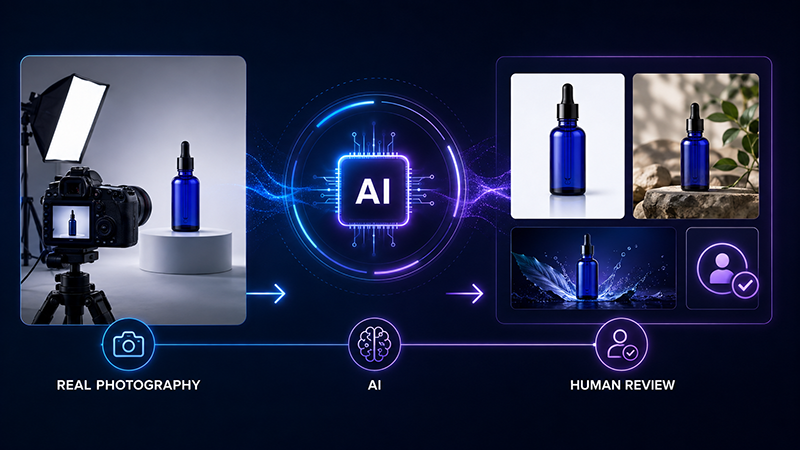
In a hybrid workflow:
- The real product is photographed accurately.
- The best source images are cleaned and prepared.
- AI is used to explore scenes, formats and campaign variations.
- A designer or photographer refines the strongest outputs.
- Every image is checked against the real product.
- Approved assets are exported for specific channels.
This model uses real photography as the source of truth and AI as a system for expansion.
It is especially effective because it does not force brands to choose between authenticity and efficiency. The product remains real. The production possibilities become wider.
How AI Affects Different Product Categories
AI product photography does not perform equally across every product type. Each category introduces different creative opportunities and accuracy risks.
Fashion and apparel
AI can generate on-model images, new poses, locations and styling directions. It is useful for campaign exploration and additional catalog content.
The primary risks are inaccurate fit, changing garment length, distorted prints, incorrect seams and unrealistic fabric behavior.
Beauty and cosmetics
Cosmetics work well in generated studio scenes because packaging can be placed among ingredients, textures, water, flowers or abstract materials.
Teams must closely inspect label text, cap shape, bottle transparency, product color and reflected surfaces.
Jewelry
AI can create luxury environments and atmospheric campaign imagery. Jewelry remains difficult because small structural details, stones, clasps and reflections must be exact.
A generated ring that changes the number or shape of stones is not a valid product image, no matter how beautiful it appears.
Furniture and home products
Furniture can be placed into multiple interior styles without building physical rooms. This is valuable for showing how an item fits different aesthetics.
Scale and perspective must be checked carefully. A chair, table or lamp should not appear to have dimensions different from the real product.
Food and beverages
AI can help create seasonal scenes, serving suggestions and advertising concepts. Food imagery carries a high risk of adding ingredients, changing portion sizes or creating textures the real product does not have.
Electronics
AI can create clean technology environments and lifestyle scenes. Screens, buttons, ports, logos and product thickness are common areas of error.
Generated images should never imply features, accessories or interface elements that are not part of the product.
A Practical AI Photography Framework for Ecommerce Brands
Brands do not need to choose between using AI everywhere and avoiding it entirely. They need rules.
1. Define the role of each image
Before generating anything, decide whether the asset is intended for:
- a primary marketplace listing;
- a product-detail page;
- a lifestyle gallery;
- a paid advertisement;
- social media;
- or a conceptual campaign.
The closer the image is to the purchasing decision, the stricter the accuracy standard should be.
2. Create a protected product layer
Whenever possible, preserve the real product as a protected visual element rather than asking the model to redraw it completely.
High-quality cutouts, masks and source photographs reduce the likelihood that AI will invent structural details.
3. Build an accuracy checklist
Every brand should maintain a category-specific checklist covering:
- logo and text;
- color;
- shape;
- material;
- proportions;
- included accessories;
- and product function.
4. Separate creative approval from product approval
An art director may approve the composition, lighting and mood. A product specialist should verify that the item itself remains correct.
One person may perform both roles in a small business, but both questions must still be asked.
5. Test the image in context
An asset that looks impressive at full size may fail inside a product grid or mobile advertisement.
Review AI images:
- on desktop and mobile;
- beside other catalog images;
- at thumbnail size;
- with the actual product title and price;
- and on the platform where the image will appear.
6. Keep the original files
Store the source photo, masks, generated versions, edited file and final export separately.
This makes it easier to correct an error, update a campaign and understand how the final image was produced.
7. Decide when real photography is non-negotiable
A physical shoot is often the better choice when:
- the product has complex transparent or reflective materials;
- small details are central to its value;
- the campaign depends on authentic human emotion;
- the image must document an exact product feature;
- or the brand is creating its primary long-term visual identity.
8. Use AI to expand, not disguise
AI should help a brand communicate the product more effectively. It should not be used to conceal poor quality, invent missing features or create an expectation the real item cannot meet.
What Comes Next for Ecommerce Photography?
The next stage of AI ecommerce photography will be less focused on generating isolated images and more focused on connected, intelligent production systems.
Brand-aware image generation
Tools are becoming better at referencing existing brand assets, colors, compositions and campaign styles. Instead of beginning every prompt from zero, teams will increasingly generate within a defined visual system.
Product-aware models
Future tools will need a more stable understanding of individual products. A brand may upload verified references, dimensions, packaging files and approved angles so that generated scenes preserve the object more accurately.
Images that adapt to the shopper
Ecommerce visuals may become more responsive to context. A shopper could see a product presented in a style, room, season or use case that reflects their search.
This raises new questions about consistency. Personalization can make an image more relevant, but every version must still represent the same real product.
Still images will become moving assets
Product photographs will increasingly become the foundation for short motion graphics, animated advertisements and interactive presentations.
A single approved image may produce:
- a subtle camera movement;
- a rotating product view;
- an animated background;
- a vertical social clip;
- or a short product demonstration.
Provenance will become part of the workflow
As synthetic images become harder to distinguish from photographs, brands will need better records of where assets came from and how they were edited.
Image provenance may become as important as file resolution, color profile and usage rights.
Human taste will become more visible
When technically polished imagery becomes abundant, the difference between brands will not come from access to generation alone.
It will come from taste.
The strongest teams will know:
- which concept deserves to exist;
- which variation should be rejected;
- when an imperfect real photograph feels more persuasive;
- how to build visual consistency;
- and how to use AI without allowing the brand to look like everyone else.
Frequently Asked Questions
How is AI changing ecommerce photography?
AI is making ecommerce photography faster, more flexible and easier to scale. Brands can create backgrounds, lifestyle scenes, campaign variations and platform-specific assets from a smaller set of original product photographs. It is also changing the role of photographers, who increasingly manage creative direction, source capture and quality control.
What is AI product photography?
AI product photography is the use of artificial intelligence to create, edit or enhance commercial product images. It may involve background removal, generated scenes, relighting, image expansion, virtual models, upscaling or the creation of additional campaign visuals.
Can ecommerce brands use AI-generated product images?
Yes, but the image should accurately represent the real product and comply with the rules of the marketplace, advertising platform and country in which it is used. Product details, colors, quantities, dimensions and functions should not be misrepresented.
Will AI replace product photographers?
AI is likely to automate some repetitive production tasks, but professional photographers will remain important for source photography, complex products, creative direction, lighting, brand storytelling and quality control. The role is evolving toward hybrid image production.
Are AI product images trustworthy?
They can be trustworthy when they are created from accurate source material and carefully reviewed. They become unreliable when AI changes the product’s form, color, packaging, text, materials or apparent function.
Is AI product photography better than traditional photography?
Neither approach is universally better. Traditional photography offers direct control and reliable product truth. AI offers speed, experimentation and variation. A hybrid workflow often provides the strongest balance.
Can AI create lifestyle product images?
Yes. AI can place a real product into generated interiors, outdoor scenes, seasonal environments and other lifestyle contexts. The lighting, perspective, scale and product details must be checked before publication.
Should AI-generated ecommerce images be disclosed?
Disclosure requirements vary by platform and jurisdiction. Brands should consider disclosure when an image is highly synthetic, features virtual people, significantly reconstructs the product or could create a false impression about what is real.
What products are hardest to photograph with AI?
Products with small text, transparent materials, reflective surfaces, complex jewelry details, intricate patterns or exact technical features are often difficult. These categories require especially careful review and may still benefit from traditional photography.
What is the future of ecommerce photography?
The future is likely to be hybrid. Real photographs will establish product truth, while AI will create additional scenes, formats, campaign variations and motion assets. Human creative direction and quality control will remain essential.
Continue Exploring AI Product Photography on DesignRise
AI is changing not only how ecommerce images look, but also how creative teams produce, adapt and distribute them. Continue with these practical DesignRise guides:
AI Product Photography Workflow: From Raw Product Photo to Marketplace-Ready Image
— follow a practical process for cleaning, transforming, reviewing and exporting product visuals.
Blend Images Using AI: 10 Creative Tips for Designers
— learn how to combine source images, generated environments and visual concepts more convincingly.
Final Thoughts: Ecommerce Photography Is Becoming a Question of Judgment
AI has already changed the speed of ecommerce photography. The deeper transformation is only beginning.
Product images are becoming more fluid. They can be rebuilt for new formats, new markets and new campaigns. A small brand can explore visual ideas that once required a substantial production. A large retailer can update an enormous catalog without reshooting every product for every context.
That creative freedom is real. So is the responsibility that comes with it.
Ecommerce photography sits close to the moment of purchase. Its job is not only to attract attention, but to help someone understand what they are about to buy.
The brands that benefit most from AI will not be the ones that generate the largest number of images. They will be the ones that establish the clearest line between enhancement and deception, between creative possibility and product truth.
Real photography will continue to matter because customers still need evidence. AI will continue to grow because brands need speed, variation and creative range.
The future belongs to teams that can combine both.
For DesignRise, the future of ecommerce photography is not a choice between human creativity and artificial intelligence. It is a new creative discipline built around both. Real photography provides evidence. AI provides scale, variation and experimentation. Human judgment determines whether the final image remains useful, distinctive and worthy of trust.
That is the standard ecommerce brands should aim for in 2026: not more synthetic content for its own sake, but better visual systems that help customers see the product clearly and help brands communicate it with greater imagination.
Discover more from DesignRise
Subscribe to get the latest posts sent to your email.