





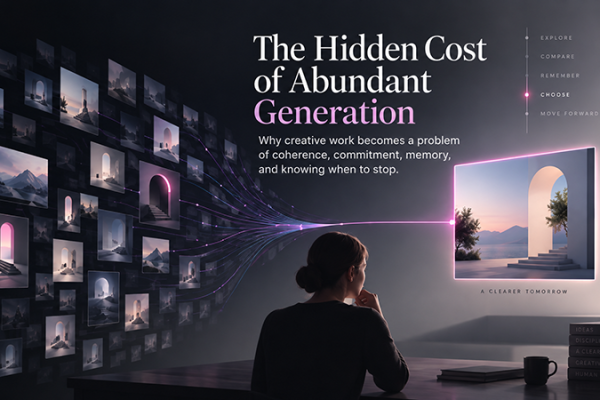


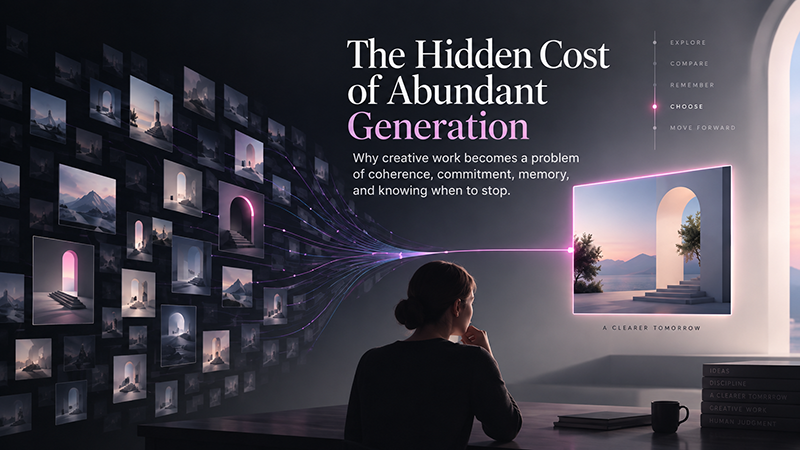
Why creative work becomes a problem of coherence, commitment, memory, and knowing when to stop.
Expert contributor article by Klimenko VG.
Abundant generation changes creative work in a way that is easy to underestimate. When generative AI makes it cheap to ask for another version, the bottleneck does not disappear. It moves. The scarce resource becomes judgment: coherence, commitment, memory, responsibility, and knowing when to stop.
Generative AI has made it extraordinarily cheap to ask for another possibility.
For creative work, that changes more than speed.
For most of its history, production has operated under material constraints. Another recording, another arrangement, another visual treatment, or another substantial revision required time and effort. Exploration had a cost, and that cost naturally limited how far a project could branch.
Generative systems weaken that constraint. A creator can now move through possibilities at a rate that would previously have been impractical.
At first, this looks like the removal of a bottleneck.
In practice, it can create a different one.
DesignRise editorial note: This article is a practitioner perspective on AI-assisted creative production. Any copyright-related reference is included as creative-workflow context, not as legal advice.
When Output Stops Being the Bottleneck
The problem is not simply that there are more things to choose from. The deeper problem is that every plausible new direction can alter the identity of the work itself.
Once possibility becomes abundant, maintaining coherence becomes creative work.
A creative project can now generate more options than a person can meaningfully evaluate. That changes the nature of the task. The creator is no longer limited only by the ability to produce material. The creator is limited by the ability to recognize what still belongs, what has become a distraction, and what should disappear.
In this environment, creative judgment becomes more valuable, not less. The work is no longer only about making. It is also about selecting, rejecting, preserving, remembering, and stopping.
A Project Can Improve Its Way Into Becoming Something Else
A creative work develops an identity long before it is finished.
That identity is not necessarily written down. It may exist in a melodic relationship, the tension between two sections, the restraint of a visual composition, an intentional imperfection, or simply the feeling that one element belongs while another does not.
Generative systems are extremely good at challenging those boundaries because they can continuously propose alternatives.
Some alternatives are obviously unusable. Those are easy.
The more difficult ones are genuinely good.
A new version may be cleaner than the previous one but emotionally flatter. Another may introduce an exciting idea that changes the center of gravity of the entire piece. A technically stronger result can solve one problem while quietly removing the characteristic that made the work distinctive in the first place.
This creates a strange possibility: a project can improve repeatedly and still become worse.
Not because the individual changes are poor, but because local improvements do not guarantee global coherence.
That distinction has become increasingly important in my own work.
I am an independent composer and artist, and generative systems are used downstream in my production process to develop possible realizations of my own compositions and source lyric material. Over months of sustained work, that process has accumulated more than 20,000 generations.
This number is offered as a practitioner observation from one sustained creative workflow, not as a scientific benchmark or an industry-wide statistic.
At that scale, one lesson becomes difficult to ignore:
The dangerous output is often not the bad one. It is the convincing one that takes the work somewhere it should not go.
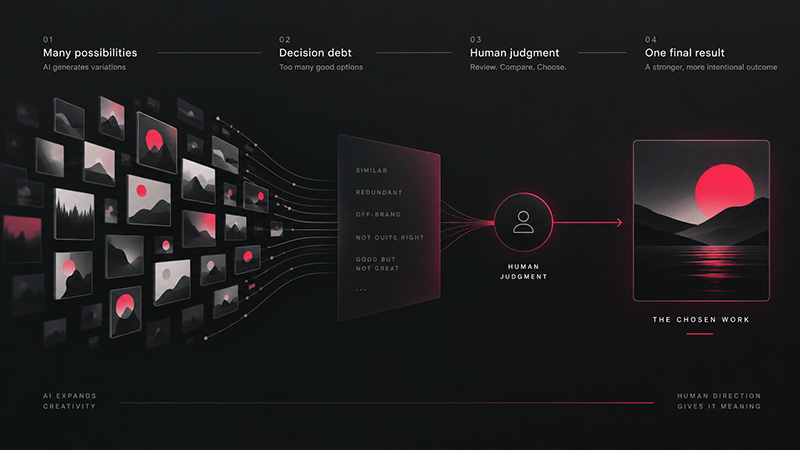
The Emergence of Decision Debt
Software development has long understood technical debt: a convenient decision made today can create a cost that has to be paid later.
Abundant creative generation produces something analogous, although the mechanism is different.
I think of it as decision debt.
This is not a scientific category. It is a practical description of what happens when a creative process produces unresolved possibilities faster than the creator closes them.
Imagine that one direction has the strongest structure, another has the most interesting texture, and an earlier version still contains the emotional quality that disappeared during later refinement.
None of those versions is simply wrong.
That is precisely the problem.
Each surviving possibility leaves behind an unresolved decision. Continue long enough and a project can accumulate a network of alternatives, exceptions, and abandoned branches that remain psychologically active even when they are no longer visible in the current version.
At that point, generating more material may feel productive while actually postponing commitment.
This changes how I think about efficiency.
The fastest creative workflow is not necessarily the one that produces alternatives fastest. It may be the one that prevents unresolved alternatives from accumulating without purpose.
Generation speed and production progress are not the same measurement.
| Creative Condition | What It Looks Like | Hidden Cost |
|---|---|---|
| Abundant output | More versions can be produced quickly. | The creator must evaluate more possibilities. |
| Convincing alternatives | Several directions appear valid. | Commitment becomes harder. |
| Branching workflow | Rejected versions still contain useful fragments. | Memory and continuity become difficult to preserve. |
| Endless iteration | Another version is always possible. | Completion must become an active decision. |
Rejected Work Is Not Wasted Work
This leads to a counterintuitive consequence.
When producing another option becomes cheap, rejection becomes more important.
Creative culture tends to celebrate what survives: the selected photograph, final edit, released recording, approved design, or published paragraph.
But rejected possibilities can perform an important function.
They establish boundaries.
Following a direction far enough to discover that it destroys the character of a work is useful information. Returning to an earlier version after testing a technically superior alternative is not necessarily regression. It can be evidence that the experiment clarified what matters.
In that sense, rejection can produce knowledge without producing an artifact.
This is easy to underestimate because rejected work disappears from the final presentation.
An audience cannot see the design direction that was abandoned because it made the brand generic. It cannot hear the musical branch that was technically impressive but emotionally wrong. It cannot read the paragraph that explained everything correctly while damaging the rhythm of the article.
Yet those absences help define the finished work.
Generative systems make this invisible layer much larger.
The ability to create more candidates therefore increases the importance of knowing what deserves to disappear.
The Memory Problem
There is another consequence of working with large numbers of alternatives: creative judgment depends on memory.
Not just storage.
A system can preserve every file and every version without preserving an understanding of why one mattered.
Creative memory contains relationships:
- This earlier version had more tension.
- That imperfection gave the section character.
- This experiment solved the technical problem but changed the emotional one.
- That abandoned direction contains something worth recovering, but not everything.
Those relationships are difficult to represent as simple version history.
As AI tools become more integrated into creative workflows, preserving context will therefore mean more than recording what happened. It will require preserving why previous decisions were made.
That distinction matters for collaborative work as well.
A future creative system may have perfect access to every previous artifact and still misunderstand the project if it cannot distinguish between a discarded experiment and an intentional reference point.
An archive contains possibilities.
A creative history contains reasons.
Those are not the same thing.
Infinite Iteration Creates a Stopping Problem
Traditional production constraints often helped finish creative work.
Studio time ended. A print deadline arrived. Reshooting became too expensive. Another revision required enough effort that it had to justify itself.
Generative systems weaken some of those natural stopping mechanisms.
If another variation costs seconds rather than hours, why stop at version 20?
Why not see version 21?
And if 21 contains one interesting improvement, why not create 22 around it?
There is no technical endpoint.
This creates what I think is one of the least discussed problems in generative creative work: completion becomes an active decision rather than the consequence of exhausted possibilities.
A system can always propose another answer.
A creator eventually has to refuse the invitation.
That requires a different discipline from ideation.
Ideation asks what else might exist.
Completion asks whether another possibility still serves the work.
Those questions can point in opposite directions.
The ability to continue indefinitely is a technological capability. The ability to recognize when continuation has stopped adding meaning is a creative capability.
That difference will become more important as generation becomes faster and more autonomous.
Generation and Production Are Different Operations
One reason abundant generation creates confusion is that generation and production can appear to collapse into the same act.
They are not the same operation.
Generation creates candidate states. It produces possible versions, directions, textures, arrangements, images, edits, passages, or structures.
Production is the decision history between states. It includes selection, rejection, redirection, preservation, recombination, modification, and final approval.
This distinction matters because a single prompt cannot explain a long creative history. A finished work may contain material that passed through many generated possibilities, abandoned branches, partial recoveries, and human decisions before reaching its final form.
In that kind of workflow, the prompt is not the whole story. It is one moment inside a larger production history.
The Prompt Follows the Work
In sustained creative production, intention does not remain fixed at the moment of the first prompt.
A more realistic pattern looks like this:
- The creator begins with an intention.
- The intention becomes an instruction.
- The system produces a result.
- The creator listens, compares, evaluates, and rejects or preserves parts of it.
- The result changes the creator’s understanding of the work.
- The next instruction reflects that revised understanding.
In this sense, the prompt follows the music, the image, the edit, or the evolving work. It does not stand above the process as a complete explanation of authorship or production.
A long AI-assisted workflow may contain substantial machine contribution and substantial human creative contribution at the same time. Reducing that workflow to a binary label — human or AI — can flatten the actual creative process.
Creative Authority Is About Consequences
Discussions about AI and creativity often focus on how much of a process was automated.
That can be useful, but it misses another important question:
Where did creative authority reside?
Authority is not simply the ability to initiate an output.
It is the ability to make consequential decisions about the work.
- Who determines that a technically stronger version should be rejected?
- Who decides that an unexpected mutation should change the direction of the project?
- Who protects the elements that must remain stable?
- Who decides that an attractive possibility belongs somewhere else?
- And eventually, who says the work is finished?
These decisions become especially significant when a system can produce persuasive alternatives indefinitely.
The more competent automated execution becomes, the easier it is to confuse plausibility with intention.
But something can be plausible without belonging.
It can be polished without being resolved.
It can be impressive without being necessary.
Creative authority is the capacity to recognize those differences and accept responsibility for what remains.
A Better Vocabulary for AI-Assisted Creative Work
If creative workflows become more complex, the vocabulary around them needs to become more precise.
A useful framework should be able to separate several layers that often get collapsed together:
- Underlying authorship: the human-authored source material, intention, composition, lyrics, concept, or original expressive input.
- Generated material: machine-generated candidate states, alternatives, or production outputs.
- Selection: the human decision to preserve one possibility and reject another.
- Arrangement: the human organization of material into a coherent structure.
- Modification: changes made to generated or human-authored material during production.
- Final responsibility: the decision to approve, publish, release, or present the finished work.
This vocabulary does not solve every legal, ethical, or artistic question. But it gives creators, platforms, and audiences a more realistic way to discuss AI-assisted production.
The U.S. Copyright Office’s 2025 report on copyrightability and artificial intelligence is useful as external context here because it discusses human-authored expressive inputs, prompting, arrangement, and modification of AI-generated outputs. For this article, that source is used only as supporting context for creative-workflow discussion, not as legal advice or as a legal conclusion about any specific work.
Key idea: Generation is not production. Production is the history of decisions that determines what survives, what changes, what disappears, and what finally becomes the work.
Abundance Changes What Is Scarce
Generative AI is often described as a technology of creation.
I increasingly think its more interesting effect may be economic in a broader sense: it changes the distribution of scarcity inside creative work.
Possibilities become cheap.
Attention does not.
Memory does not.
Coherence does not.
Commitment does not.
Responsibility does not.
And completion certainly does not.
This means the competitive advantage of a creative professional may gradually move away from the ability to produce the greatest number of alternatives.
The advantage may instead belong to the person who can move through abundance without losing the identity of the work.
That requires exploration, but also resistance.
It requires knowing when a new direction is discovery and when it is distraction.
It requires remembering why an earlier decision mattered.
It requires allowing useful experiments to die.
And ultimately it requires something no endless generator needs to possess:
the willingness to decide that there should not be another version.
Related DesignRise Reading
To continue exploring creative AI, design agents, and AI-assisted workflows, read these related DesignRise resources:
- Creative AI Agents Need a Context Handoff Test Before They Scale
- AI Design Agents: How They’re Changing Creative Workflows
- AI Design Workflow in 2026
- Figma AI Agent Workflow: How Designers Can Use AI Without Losing Control
Sources and Further Reading
- U.S. Copyright Office — Copyright and Artificial Intelligence, Part 2: Copyrightability
- DesignRise — Creative AI Agents Need a Context Handoff Test Before They Scale
- DesignRise — AI Design Agents: How They’re Changing Creative Workflows
About the author
Klimenko VG is an independent composer and artist and the founder of Binary Area Records. His work explores human authorship, production judgment, and creative responsibility in workflows that use generative systems as downstream production tools.
Discover more from DesignRise
Subscribe to get the latest posts sent to your email.