


Expert contributor article by Gleb Tsipursky, PhD
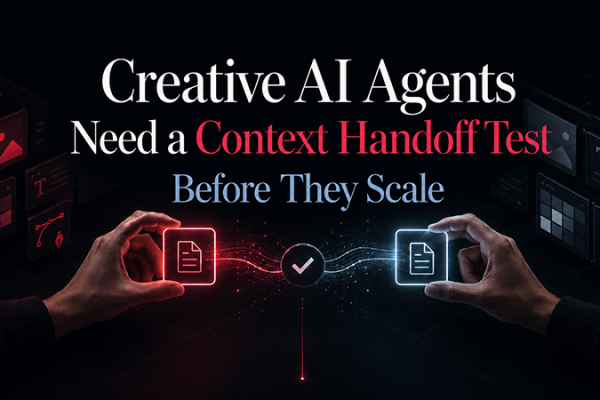
Creative AI agents are changing how designers and creative teams handle research, ideation, content generation, prototyping, and production. But as these workflows become more autonomous, one major risk grows with them: losing context when work moves between tools, operators, or approval stages.
As creative AI agents become more capable, teams need stronger systems for preserving brand logic, product truth, decision history, and human review.
Creative AI is moving beyond the single prompt. Designers increasingly use AI across research, concept development, copy, image generation, prototyping, revision, documentation, and production. The next step is agentic: systems that can carry out several connected tasks, call tools, preserve state, and move work forward with less human prompting.
That progression creates a less obvious risk. A workflow can become faster while becoming more dependent on context that only one person understands.
Scaling creative AI agents safely requires more than better prompts. It requires a system for preserving decisions, constraints, and review criteria.
Google Cloud’s August 24, 2026 research on autonomous agents offers a useful warning. The company notes that agents increasingly receive permission to read email, query databases, and trigger APIs, while 79% of surveyed technology leaders identify security, governance, or operations as their most significant challenge to scaling AI inference. Creative workflows do not usually carry the same operational risk as enterprise infrastructure, but they face the same structural problem: autonomy expands faster than the surrounding control system.
DesignRise editorial context
This expert contribution connects directly to DesignRise’s coverage of AI design agents, controlled creative workflows, product truth, and human review. It introduces a practical 30-day context handoff test for teams preparing to scale AI-assisted creative operations.
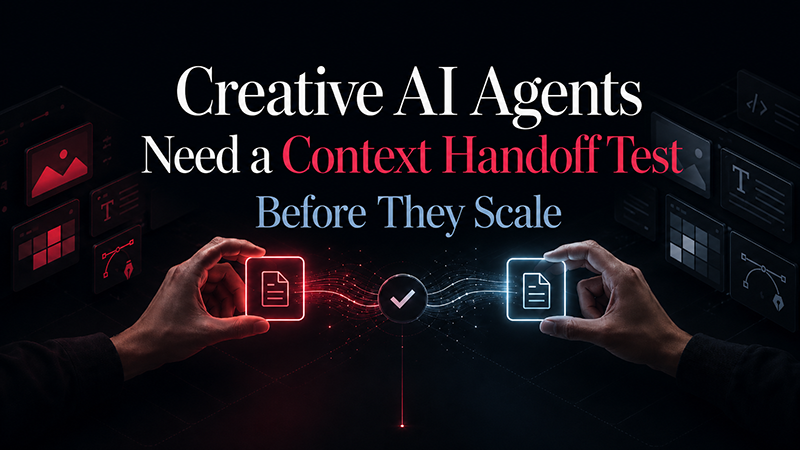
Why Creative AI Agents Need a Context Handoff Test
The real challenge with creative AI agents is not only automation, but whether the workflow remains usable when a different person takes over.
For design teams, the scarce resource is often context.
A strong designer knows why the client rejected the first direction, which brand rule can bend, which product detail must remain exact, what the research actually supports, and which apparently attractive output would create a usability or trust problem. AI can help express and transform that context. It does not automatically make the context portable.
DesignRise’s own current guidance makes this clear. Its AI design workflow treats AI as a thinking partner and production accelerator while keeping strategy, taste, usability, brand consistency, and final quality with the designer. Its virtual try-on workflow goes further by treating product truth, accuracy review, customer experience, and controlled scale as connected layers rather than a single generation step.
That is the right direction. The next useful test is whether the workflow still works when the original builder steps away.
The core question
Can a second qualified person operate the AI-assisted workflow without a private briefing from the original builder?
The 30-Day Context Handoff Test for Creative AI Agents
Call it the context handoff test.
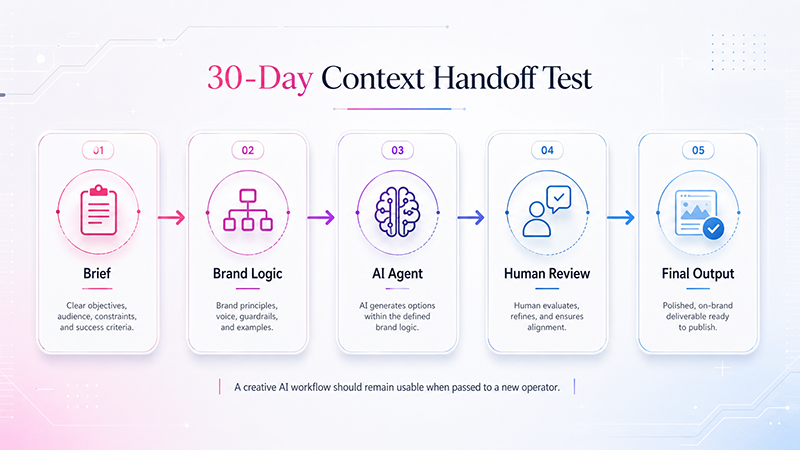
For 30 days, a creative team should choose one meaningful AI-assisted workflow and test whether a second qualified person can operate it without a private briefing from the original builder. The goal is not to remove human judgment. The goal is to discover where the judgment lives and whether the workflow preserves enough of it to scale safely.
| Test element | What it reveals |
|---|---|
| Second-operator handoff | Whether the workflow can continue without private verbal knowledge. |
| Tool or model substitution | Whether the logic exists outside one interface or model. |
| Realistic exception | Whether the operator can catch conflicts before AI scales the mistake. |
| Outcome review | Whether the final work still meets business, brand, usability, and accuracy requirements. |
Start by Mapping the Context Stack
Every creative workflow has several kinds of context, even when nobody has named them. There is business context: what outcome the work should support. There is audience context: who the user is and what problem matters to them. There is brand context: voice, visual language, constraints, and strategic positioning. There is asset context: source files, product facts, approved claims, and reference imagery. There is decision context: what was tried, what failed, and why a direction changed. Finally, there is risk context: the details that must not drift because they affect accuracy, rights, usability, or customer trust.
The context stack
Business context → Audience context → Brand context → Asset context → Decision context → Risk context
Teams often put some of this information in a brief and leave the rest inside chat histories, file names, Slack threads, or one experienced designer’s memory. That arrangement can work while the same person drives the workflow. It becomes fragile when AI takes more steps autonomously or the work moves to another person.
For creative teams, the real test of creative AI agents is not whether they can generate more output, but whether they can preserve intent across the process.
How to Run the Test
The first part of the test is therefore simple: give the second operator the normal workflow materials and ask them to continue the project.
Do not let the original builder explain anything verbally. Measure the questions the second operator has to ask, the files they cannot find, the decisions they cannot reconstruct, and the moments when they have to guess.
Those gaps are context debt.
Next, run a controlled change. Replace one tool, model, or integration while keeping the creative objective constant. A mature workflow should tolerate some substitution because the project logic exists outside the interface. If changing the model destroys the process, the team may have built a tool-specific routine rather than a durable creative system.
Test Realistic Exceptions Before Scaling
Then test a realistic exception.
For an ecommerce workflow, introduce an asset with an incorrect colorway, missing product detail, or conflicting source information. For a brand workflow, provide a request that violates an established brand constraint. For a UX workflow, introduce feedback that conflicts with the original objective. The second operator should be able to recognize the conflict, find the governing context, and decide whether to proceed, escalate, or reject the AI output.
This matters because creative AI failures can look good. A photorealistic product image can still misrepresent the product. A polished landing page can still contradict the positioning. A fluent interface can still make the user’s task harder. Visual plausibility is a weak substitute for preserved intent.
DesignRise’s virtual try-on framework captures this distinction particularly well by separating whether a generated image looks believable from whether it still represents the real product accurately. The same distinction should govern agentic creative work more broadly. Teams need to ask both whether the output looks competent and whether it remains faithful to the facts and decisions that gave the project meaning.
DesignRise principle
Visual plausibility is not the same as preserved intent. In creative AI workflows, the output must look competent and remain faithful to the business, brand, product, and review context that shaped the project.
That is why teams experimenting with creative AI agents should test how well context survives handoffs, revisions, tool changes, and exceptions before they scale the workflow across a larger organization.
Five Measures That Reveal Context Debt
The context handoff test can produce five useful measures.
- Handoff time: how long does a qualified second operator need before productive work resumes?
- Clarification load: how many questions require the original builder or another senior expert?
- Reconstruction failures: how often can the second operator see what happened but not why it happened?
- Exception recovery: can the new operator identify and resolve a deliberately introduced problem without damaging the project?
- Outcome stability: after the handoff, does the work still meet the original business, brand, usability, and accuracy requirements?
Create a Context Budget
A team can turn those measures into a simple context budget. If each 100 AI-assisted actions require hours of explanation, repeated senior rescue, or reconstruction of missing decisions, the automation is consuming more organizational context than it preserves. Scaling it will spread the problem.
The remedy is not more documentation for its own sake. Teams should capture only the context that repeatedly proves necessary.
| If the second operator cannot… | Create… |
|---|---|
| Tell which source image is authoritative | A source-of-truth rule |
| Recover why a brand decision changed | A short decision log |
| Prevent repeated product-detail drift | A do-not-change field |
| Know whether an asset was approved | Provenance and approval state |
| Understand undocumented prompt decisions | Prompt purpose and decision logic |
When a second operator cannot tell which source image is authoritative, create a source-of-truth rule. When brand decisions disappear inside chat histories, maintain a short decision log. When an AI system repeatedly violates the same product detail, encode a do-not-change field. When nobody knows whether a generated asset was approved, preserve provenance and approval state with the asset. When a workflow depends on undocumented prompts, record the purpose and decision logic behind them rather than merely copying the prompt text.
Do Not Confuse a Reusable Prompt With a Reusable Workflow
This is also where creative teams should resist an easy mistake: confusing a reusable prompt with a reusable workflow.
A prompt can travel while the surrounding judgment does not. The person receiving it may not know when to reject the result, what evidence to verify, or which trade-off the original designer made. A truly reusable workflow carries enough context for another qualified person to make those decisions well.
That makes the handoff test valuable for agencies, internal design teams, and ecommerce operations alike. Agencies can reduce dependence on one account lead. Internal teams can make AI workflows resilient to turnover and vacations. Ecommerce teams can scale product imagery without losing product truth. Freelancers can create processes clients or collaborators can actually inherit.
Agentic design will make creative work more fluid across tools. That is precisely why teams need to make the important context less fluid.
As creative AI agents become more common in design teams, the handoff between people, tools, and approval stages becomes part of the workflow itself.
Related DesignRise reading
Final Thoughts
Before giving an AI agent more autonomy, ask another human to take over the workflow. If the second operator can preserve the intent, catch the exceptions, recover from a failure, and produce the same quality of business outcome, the system is becoming scalable.
If the workflow only works because its original builder is standing nearby, the organization has automated the visible work while leaving the real operating system inside one person’s head.
For creative teams, the best use of creative AI agents is not to remove judgment from the process. It is to make the workflow more repeatable while keeping the brief, brand logic, product truth, and final review visible enough for another qualified person to continue the work.
Sources and further reading
About the author
Gleb Tsipursky, PhD, a behavioral scientist, CEO of Disaster Avoidance Experts, and author of The Psychology of AI Adoption at Work: From Resistance to Results (Georgetown University Press, 2026).
Discover more from DesignRise
Subscribe to get the latest posts sent to your email.