

How AI Changed the Way I Start a Branding Project
The beginning of a branding project has always been messy for me.
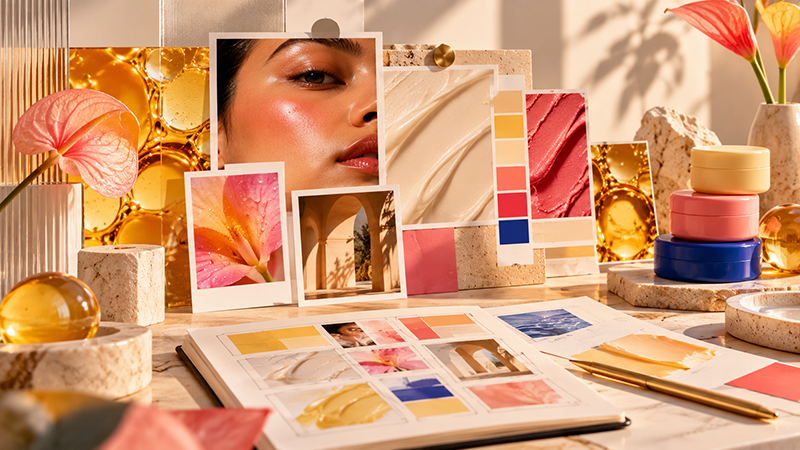
Before there’s a logo, a typeface or a color palette, there’s a much less tangible phase: reading, collecting references, understanding the category, asking questions, building moodboards and trying to figure out which directions have enough potential to become something bigger.
AI hasn’t removed that part of my process. What it has changed is how quickly I can move between thinking about an idea, seeing it and testing it.
And some of the most useful applications have surprisingly little to do with asking AI to design anything.
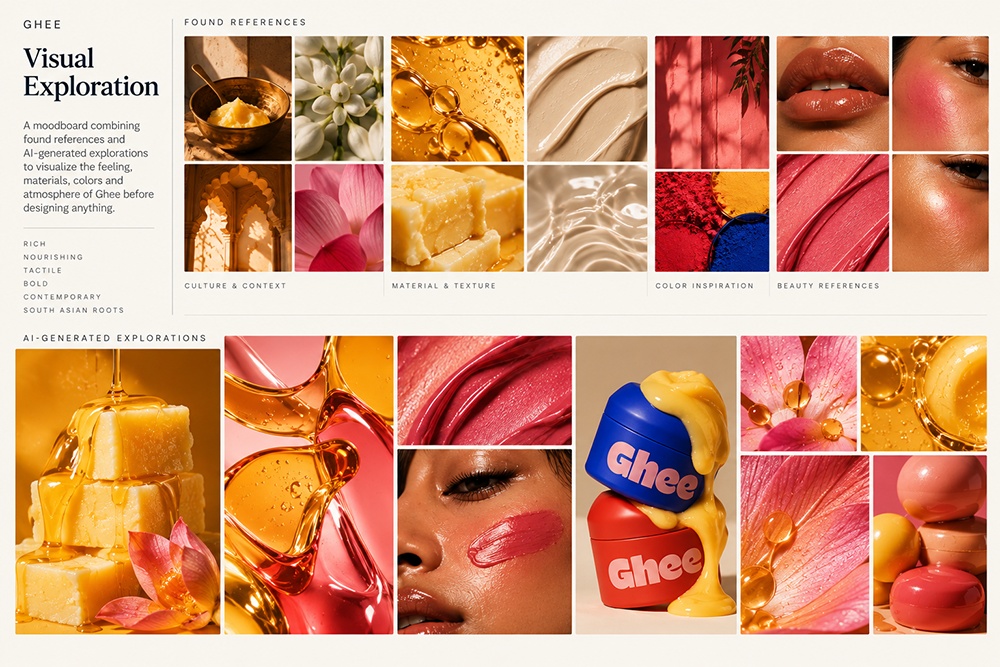
To illustrate this, I’m going to revisit Ghee, a beauty identity I designed around a line of ghee-infused makeup products. I’m not suggesting that AI created the original identity. Instead, I’m using the project to show how I would approach some of those early stages today with the tools that are now part of my process.
I start by asking more questions
One of the easiest ways to use AI is to give it a brief and ask for ideas. I rarely find that very useful.
At the beginning of a project, I don’t necessarily want answers. I want better questions.
Ghee, for example, sits at an interesting intersection. Ghee has deep roots in South Asian food and culture, while the product itself sits somewhere between skincare and makeup. An ingredient that feels deeply familiar to one audience might be completely new to another.
Today, I might use a language model to pressure-test those tensions.
What does “ghee” mean to someone who grew up with it versus someone encountering it for the first time as a beauty ingredient?
Which visual codes in skincare and cosmetics have become so common that they no longer communicate anything?
How can the brand acknowledge the ingredient’s cultural roots without turning them into decoration?
Should the identity feel nourishing and natural, expressive and cosmetic, or deliberately hold both ideas at once?
AI is useful here because it gives me something to react to. Some questions are obvious, some are irrelevant, and occasionally one exposes an assumption I hadn’t noticed.
The strategy still comes from the designer. AI simply gives me another way to interrogate the problem before I start solving it.
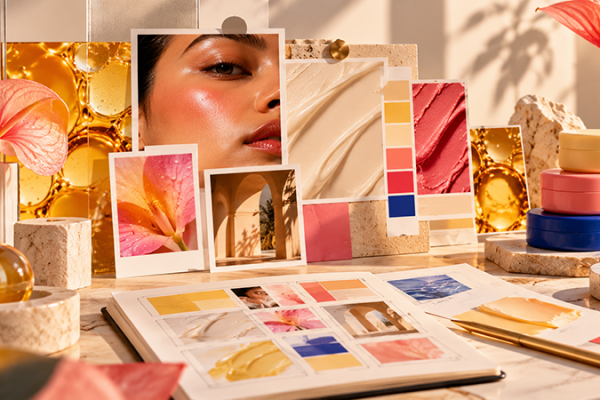
Moodboarding is no longer limited to what I can find
This is where AI has changed my process much more dramatically.
Traditional moodboarding is largely a search exercise. I have an idea in my head and look through photography, archives, books, packaging, fashion, art and the internet for images that somehow approximate it.
I still do that. In fact, I think found references have become more important, not less.
But image generation fills an interesting gap: sometimes I know the feeling I’m looking for, but an image representing it simply doesn’t exist.
For a project like Ghee, I might want to explore the tension between something rich and nourishing and something bold, playful and cosmetic.
Instead of searching endlessly for one photograph that captures both, I can create rough visual experiments.
What happens when the warmth and translucency associated with clarified butter are translated into beauty photography?
Could soft, almost edible forms coexist with saturated cosmetic colors?
Can something feel tactile and indulgent without falling into the predictable beige visual language of “natural” beauty?
I don’t think of these generated images as designs. I think of them more like visual sketches. They allow me to make something in my head tangible enough to react to.
I can test creative territories much earlier
Once I understand the space, image generation also lets me test substantially different visual worlds before investing too much time in any one of them.
For Ghee, imagine three possible starting points.
Liquid Gold
This direction leans heavily into the ingredient itself: warm light, translucency, rich yellows, macro photography and viscous surfaces.
It immediately communicates nourishment and ghee, but perhaps that’s also its weakness. It could become too literal or expected.
Cosmetic Playground
The second goes in almost the opposite direction: saturated color, strange sculptural forms, exaggerated scale and playful compositions.
It places the brand firmly in the world of contemporary beauty. But push it too far and the ingredient that makes the brand distinctive starts disappearing.
Cultural Collision
The third explores the tension between contemporary beauty and the cultural familiarity of the ingredient.
Rather than relying on literal cultural symbols, the direction could explore unexpected combinations of color, material and composition. Instead of resolving the contradiction between heritage and contemporary beauty, the tension itself becomes useful creative territory.
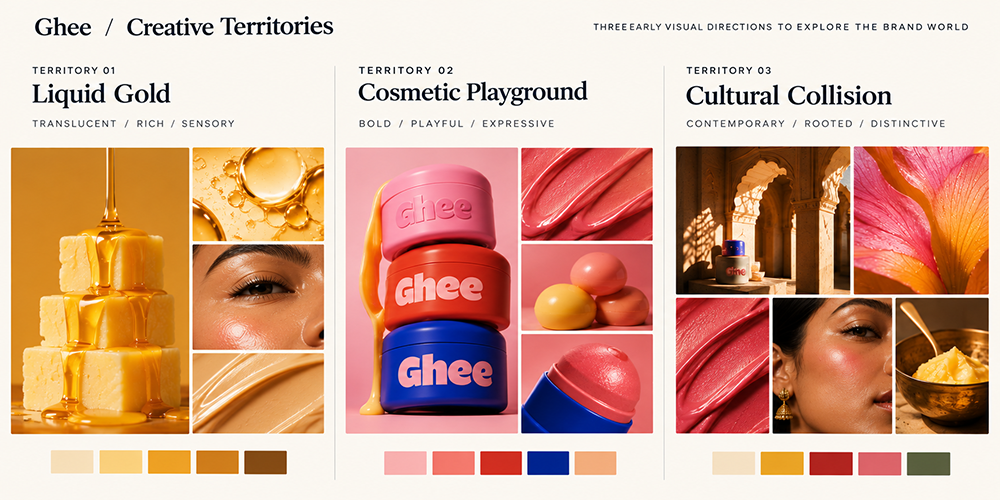
The point isn’t that AI has designed three identities for me. These are intentionally rough visual worlds that help me ask a much more useful question:
Which direction deserves to be designed?
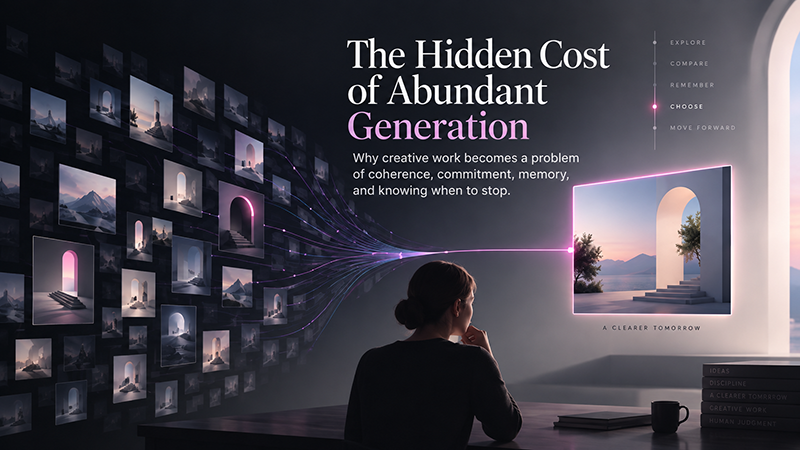
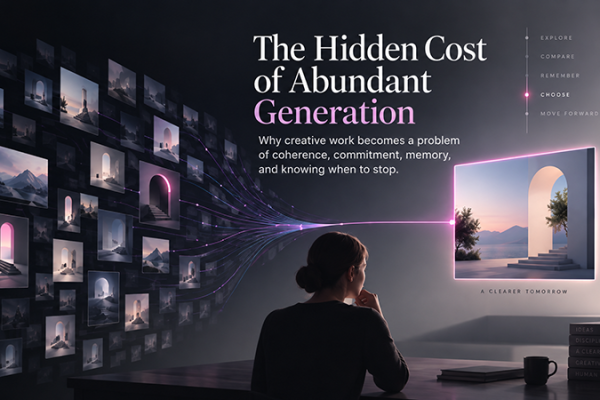
More options don’t necessarily lead to better work
This is where AI can become dangerous.
Generation makes it incredibly easy to ask: What else?
Another image. Another color. Another composition. Another direction.
Suddenly you have a folder full of beautiful images without having made a single meaningful decision.
I try to shift the question from:
Which one looks best?
to:
Which one gives me the most interesting problem to solve?
Maybe Liquid Gold communicates the ingredient immediately but feels too familiar.
Maybe Cosmetic Playground is visually exciting but could belong to almost any emerging beauty brand.
Maybe Cultural Collision feels less immediately resolved, but that tension gives it more potential.
AI helps me reach that conversation faster. It doesn’t get the final vote.
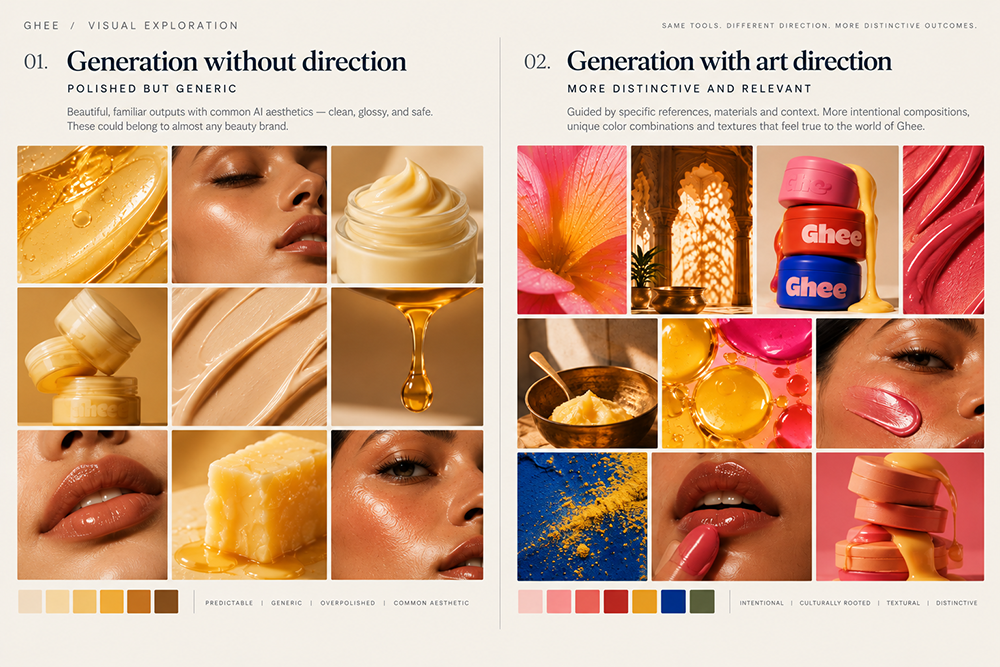
AI has a visual accent
There’s another problem that becomes obvious once you spend enough time generating images.
You start noticing the same things.
The same polished lighting. Similar surreal materials. Perfect compositions. Familiar combinations of minimalism and strangeness.
AI can make something look interesting remarkably quickly. That doesn’t mean the idea behind it is interesting.
If I stay inside that world for too long, the tool can slowly start defining the creative direction rather than helping me explore it.
That’s why generated imagery doesn’t replace references from outside the model in my process.
I still want books, photography, packaging, fashion, architecture, art, objects, materials and things I notice in everyday life.
AI is very good at remixing the visual world it knows. A designer still has to decide which parts of the world are worth bringing into the conversation.
Eventually, I have to stop generating
This might be the most important part.
AI makes exploration effectively infinite. Design isn’t.
At some point I need to stop generating references, close the moodboard and commit to an idea.
The final Ghee identity became something very specific: a bold custom wordmark, expressive color combinations, dimensional packaging and a visual world that moves away from the quiet minimalism often associated with ingredient-led skincare.
Those are design decisions.
AI might help me reach that territory faster today. It might help me visualize alternatives I couldn’t easily find through references. It might even expose a weak direction before I spend days developing it.
But it can’t remove the moment when I have to say:
This is the idea.
And then do the work of turning that idea into a coherent identity.
AI hasn’t made my process less messy
It has changed where the mess happens.
I spend less time searching for the perfect reference that exists only vaguely in my head. I can make an abstract direction visible earlier and discard weak ideas before overdeveloping them.
But that creates a different problem: abundance.
When generating becomes easy, choosing becomes harder.
That’s probably the biggest way AI has changed the beginning of my branding process. It’s not simply making me faster.
It’s allowing me to move from thinking → seeing → testing much more fluidly.
The designer’s job is still knowing when to stop exploring and start designing.
Discover more from DesignRise
Subscribe to get the latest posts sent to your email.