










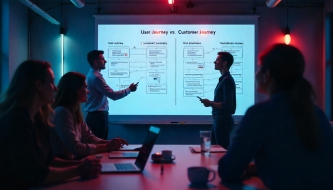
Many teams use the terms user journey and customer journey as if they mean the same thing. At first, that may seem harmless. Both describe how people move through an experience, both involve touchpoints, and both can reveal friction in a product or service.
But treating them as synonyms is more than a small terminology mistake. It can create a serious strategy problem.
A user journey focuses on how someone interacts with a product, interface, website, app, platform, or service experience. A customer journey focuses on how someone moves toward purchase, payment, loyalty, renewal, retention, or long-term business value.
Sometimes the user and the customer are the same person. Sometimes they are not. And when companies fail to recognize the difference, they can end up building beautiful products that people enjoy using but never pay for — or profitable customer flows that feel frustrating and eventually damage trust.
This guide explains the difference between user journeys vs. customer journeys, why the distinction matters, how it affects UX, CX, marketing, product strategy, and revenue, and how teams can map both journeys together without confusing their goals.
Explore More DesignRise Resources:
- How to Convert Your Figma Designs into Functional Web Apps Using Anima Playground
- Crafting Your First UX Design Portfolio: A Step-by-Step Guide
- 25 Best Free Serif Fonts for Designers
- Finger-Friendly UI Design: Mobile UX Principles Designers Should Know
What Is a User Journey?
A user journey is the path a person takes while interacting with a product, interface, or digital experience. It usually focuses on tasks, behaviors, screens, decisions, friction points, emotions, and usability.
In UX design, user journey mapping helps teams understand what people are trying to do and how smoothly the product supports that goal.
User Journey Examples
- A visitor lands on a SaaS homepage, compares features, starts a free trial, and completes onboarding.
- A mobile app user opens the app, searches for a feature, gets confused by navigation, and leaves.
- A marketplace user browses listings, applies filters, saves favorites, and contacts a seller.
- A student logs into an online learning platform, watches a lesson, takes a quiz, and tracks progress.
- A designer opens a web app, uploads a file, edits content, exports the final result, and shares it.
The user journey is usually concerned with questions like:
- Can users complete their task easily?
- Where do they experience friction?
- What information do they need at each step?
- Which screens or interactions create confusion?
- How does the product support user intent?
- What makes users abandon the flow?
A strong user journey improves usability, engagement, satisfaction, onboarding, feature adoption, and product clarity.
What Is a Customer Journey?
A customer journey is the broader path someone takes from awareness to purchase, payment, loyalty, support, renewal, advocacy, or churn. It is usually connected to business outcomes and customer relationship management.
While a user journey is often focused on product interaction, the customer journey includes every touchpoint that influences whether someone becomes, stays, or stops being a paying customer.
Customer Journey Examples
- A potential buyer discovers a brand through Google, reads reviews, compares pricing, buys a product, contacts support, and later returns for another purchase.
- A SaaS lead watches a webinar, signs up for a demo, receives sales emails, starts a paid plan, and renews annually.
- An enterprise client evaluates a software provider, involves legal and finance teams, signs a contract, completes onboarding, and expands the account.
- A subscriber signs up for a streaming platform, upgrades to a premium plan, receives personalized recommendations, and decides whether to renew.
- An advertiser uses a free platform’s audience data to place ads, track campaign performance, and increase monthly spend.
The customer journey usually focuses on questions like:
- How does someone discover the brand?
- What convinces them to trust the company?
- What objections prevent purchase?
- How does the business convert interest into revenue?
- What keeps customers loyal?
- What causes churn, refunds, or cancellations?
- How can retention and lifetime value improve?
A strong customer journey improves conversion, trust, retention, loyalty, referrals, revenue, and long-term business health.
User Journey vs. Customer Journey: The Core Difference
The simplest difference is this:
User journey = how someone uses the product.
Customer journey = how someone becomes and remains a paying customer.
That difference may sound obvious, but it becomes complicated in real business models. In many companies, the person using the product is not always the person paying for it.
| Area | User Journey | Customer Journey |
|---|---|---|
| Main focus | Product interaction and task completion | Purchase, retention, loyalty, and revenue |
| Primary discipline | UX design, product design, usability | CX, marketing, sales, customer success |
| Main question | Can users complete their goal easily? | Will customers buy, return, renew, or stay loyal? |
| Key touchpoints | Interface, navigation, onboarding, features | Ads, website, pricing, checkout, emails, support, renewal |
| Typical metrics | Task success, engagement, feature adoption, drop-off | Conversion, retention, revenue, churn, lifetime value |
| Main risk | Product feels confusing or frustrating | Business fails to convert or retain customers |
Both journeys matter. The problem begins when a team maps only one and assumes it understands the entire strategy.
1. Why Terminology Shapes Outcomes

Words shape how teams think. When a company says “user” but actually means “customer,” the strategy can become confused. Product teams may optimize for usage while business teams worry about revenue. Marketing may bring in leads, but UX may not support conversion. Sales may sell a promise that the product journey cannot deliver.
A user is someone who interacts with your product or interface. They click, scroll, search, swipe, watch, read, upload, download, save, comment, or complete a task.
A customer is someone who pays, renews, subscribes, buys, funds, sponsors, or creates direct business value.
In some products, the same person is both. In others, the roles are separate.
Why This Matters
If a company confuses users and customers, it may optimize the wrong journey. For example, a free app may focus entirely on user engagement while forgetting that advertisers are the paying customers. A B2B SaaS tool may improve the daily user workflow while ignoring the executive buyer who approves the budget. A marketplace may satisfy buyers but frustrate sellers, even though sellers provide inventory.
Clear terminology helps teams design better strategy because everyone understands which audience, behavior, and outcome they are optimizing for.
2. The Problem With a “Perfect” User Journey
Design teams often romanticize the user journey. The ideal path looks clean and emotionally satisfying:
- The user discovers the product.
- The onboarding feels effortless.
- The interface feels intuitive.
- The user finds value quickly.
- The user returns again and again.
That is important. A product with a poor user journey will struggle. But a beautiful user journey does not automatically create a sustainable business.
Users can love a product and still never pay for it. They can enjoy content without subscribing. They can browse a marketplace without buying. They can use a free tool forever while the business loses money supporting them.
This is where many startups and digital products get into trouble. They build for engagement but not conversion. They create delight but not revenue. They attract attention but fail to design the path from interest to payment.
The Strategic Mistake
The mistake is not caring too much about users. The mistake is assuming that user satisfaction alone is the same as business success.
A strong product needs both:
- user value — people can complete meaningful tasks easily;
- customer value — the business has a clear path to revenue, retention, and growth.
When the user journey is strong but the customer journey is weak, the product may become popular but financially fragile.
3. Customer Journey: The Path That Pays
The customer journey focuses on the economic relationship between a person or organization and the business. It includes everything that helps someone decide to buy, continue paying, upgrade, renew, or recommend the product.
Unlike the user journey, the customer journey is not only about ease of use. It is also about confidence, trust, pricing, timing, perceived value, proof, support, loyalty, and risk reduction.
A Customer Journey Often Includes:
- awareness and discovery;
- education and comparison;
- trust-building touchpoints;
- pricing evaluation;
- purchase or subscription;
- onboarding after payment;
- support experience;
- renewal or repeat purchase;
- upgrade opportunities;
- referrals and advocacy.
For example, a music streaming product may serve listeners beautifully, but the business model may also depend on subscribers, advertisers, artists, labels, and partners. Each group may have a different journey with different incentives.
If the company maps only the listener journey, it may miss the realities of monetization. If it maps only the advertiser journey, it may damage the listener experience. The strategy needs both.
4. When Users and Customers Are Different People
One of the most important reasons to separate user journeys and customer journeys is that the user and the customer are often not the same person.
Examples Where Users and Customers Differ
- B2B SaaS: employees use the product, but executives or department heads approve payment.
- Education platforms: students use the platform, but schools, parents, or institutions pay.
- Ad-supported apps: consumers use the product for free, but advertisers are the customers.
- Marketplaces: buyers and sellers both use the product, but monetization may depend more on one side.
- Enterprise tools: daily users care about workflow, while procurement teams care about cost, security, and compliance.
- Healthcare platforms: patients may use the interface, while providers, insurers, or organizations influence payment.
When these roles differ, one journey map is not enough. The product must serve the person using it and the person paying for it.
What Can Go Wrong
If a product team focuses only on daily users, it may create a tool people enjoy but buyers cannot justify. If it focuses only on buyers, it may sell well at first but fail when real users resist adoption.
This is especially common in enterprise products. A sales team may win a contract because the buying journey is strong, but if the user journey is poor, employees may avoid the tool, adoption may drop, and renewal may become difficult.
That is why user journey and customer journey strategy must connect.
5. When Users and Customers Are the Same Person
In direct-to-consumer products, users and customers often overlap. A person browsing an online store may also be the buyer. A person using a fitness app may also pay for the subscription. A person reading a paid design resource may also be the subscriber.
This sounds simpler, but it still creates two layers of experience.
User Experience Layer
- Can the person navigate easily?
- Can they find what they need?
- Is the interface clear on mobile?
- Is the content readable and useful?
- Is the experience enjoyable?
Customer Experience Layer
- Do they understand the value?
- Do they trust the brand?
- Is pricing clear?
- Is checkout simple?
- Do they feel confident after purchase?
- Will they return or recommend?
Even when the same person is both user and customer, the journey is not one-dimensional. A person can enjoy browsing but abandon checkout. A person can buy once but never return. A person can like the product but feel unsupported after payment.
That is why DTC brands, subscription products, ecommerce stores, and membership websites need both UX thinking and CX thinking.
6. UX vs. CX: Bridging the Design-Revenue Divide
UX and CX often live in separate mental worlds.
UX teams ask questions like:
- Is the interface intuitive?
- Can users complete tasks?
- Where does the flow break?
- Is the experience accessible?
- How can we reduce friction?
CX, marketing, sales, and business teams ask questions like:
- Will this convert?
- Will customers trust us?
- Will they renew or return?
- Will they recommend the product?
- Does the experience support revenue?
The strongest companies connect these questions. They understand that usability and revenue are not enemies. A better user journey can support a stronger customer journey. A better customer journey can create clearer expectations for users.
How to Bridge UX and CX
- Map product interactions and business touchpoints together.
- Include marketing, sales, support, UX, product, and customer success in journey mapping.
- Track both usability metrics and revenue metrics.
- Identify moments where user friction damages conversion.
- Identify moments where business pressure damages user trust.
- Design touchpoints that support both clarity and revenue.
The goal is not to turn every UX decision into a sales tactic. The goal is to create a journey where user needs and business outcomes support each other.
7. Key Metrics for User Journeys and Customer Journeys
Different journeys require different metrics. If a team uses only one set of metrics, it may misunderstand performance.
User Journey Metrics
- task success rate;
- time on task;
- onboarding completion;
- feature adoption;
- navigation success;
- search success;
- drop-off points;
- usability test findings;
- session behavior;
- engagement frequency.
Customer Journey Metrics
- conversion rate;
- trial-to-paid rate;
- cart abandonment rate;
- customer acquisition cost;
- customer lifetime value;
- retention rate;
- renewal rate;
- churn rate;
- repeat purchase rate;
- support satisfaction;
- referral rate.
A healthy strategy looks at both. If user metrics are strong but customer metrics are weak, the product may be engaging but not monetizing. If customer metrics are strong but user metrics are weak, the business may convert people but struggle with retention.
8. Common Mistakes Teams Make
Mistake 1: Mapping Only the Happy Path
Real journeys are messy. Users hesitate, compare, leave, return, ask questions, forget passwords, abandon carts, contact support, and change their minds. A useful journey map includes friction, doubt, and recovery.
Mistake 2: Treating Free Users as Customers
Free users can be valuable, but they are not always customers. If the business depends on advertisers, sponsors, or enterprise buyers, those paying groups need their own customer journey.
Mistake 3: Ignoring Post-Purchase Experience
The customer journey does not end at payment. Support, onboarding, delivery, product value, renewal, and follow-up all affect loyalty.
Mistake 4: Optimizing Conversion at the Expense of Trust
Pushy popups, unclear pricing, forced urgency, or confusing checkout flows may increase short-term clicks but damage long-term customer trust.
Mistake 5: Separating UX and Business Strategy Too Much
UX teams need to understand revenue logic. Business teams need to understand user friction. If each side works separately, the journey becomes fragmented.
Dual-Track Journey Mapping: The Better Approach
The most practical way to avoid confusion is to create a dual-track journey map. This means mapping the user journey and customer journey side by side.
Instead of asking only, “What does the user do?” you ask:
- What is the user trying to accomplish?
- What is the customer deciding at this stage?
- Where do user value and business value align?
- Where do they conflict?
- What touchpoints support both?
- What metrics should we track?
Dual-Track Journey Map Structure
| Stage | User Journey Focus | Customer Journey Focus | Strategic Question |
|---|---|---|---|
| Awareness | Can the user understand the product quickly? | Does the brand create trust and interest? | Are we attracting the right audience? |
| Evaluation | Can the user explore value easily? | Does the customer understand pricing and proof? | Are objections answered clearly? |
| Onboarding | Can the user reach first value? | Does the customer feel purchase confidence? | Does onboarding support retention? |
| Usage | Can the user complete tasks repeatedly? | Does the product justify continued payment? | Is daily value connected to business value? |
| Support | Can the user solve problems? | Does support protect loyalty? | Are issues resolved before churn? |
| Renewal / Repeat | Does the user still find value? | Does the customer have a reason to continue? | What drives retention or repeat purchase? |
This approach makes the strategy more realistic. It helps teams see where product delight supports business growth and where the two journeys need different solutions.
Practical Workflow: How to Map Both Journeys
Step 1: Identify All Roles
List every person involved: users, buyers, decision-makers, influencers, administrators, support teams, advertisers, partners, or stakeholders.
Step 2: Separate User Goals From Customer Goals
Write what each group wants. A user may want speed and simplicity. A customer may want ROI, trust, proof, support, or pricing clarity.
Step 3: Map Touchpoints
Include product screens, emails, ads, search results, pricing pages, onboarding, checkout, support, renewal reminders, and follow-up communication.
Step 4: Identify Friction
Find where people hesitate, misunderstand, abandon, complain, or fail to complete the next step.
Step 5: Connect Metrics
Attach user metrics and customer metrics to each stage. For example, onboarding completion may connect to trial-to-paid conversion.
Step 6: Find Conflicts
Look for places where the business pushes too hard or the product gives value without creating a path to revenue.
Step 7: Design Better Bridges
Create touchpoints that connect user value to customer value: better onboarding, clearer pricing, trust-building content, support improvements, upgrade moments, and retention loops.
Example: SaaS Product With Free Users and Paid Buyers
Imagine a SaaS platform where individual employees use the tool for free, but team managers pay for advanced collaboration features.
User Journey
- The employee discovers the tool.
- They sign up for free.
- They complete onboarding.
- They create their first project.
- They invite a teammate.
- They hit a collaboration limit.
Customer Journey
- The team manager hears about the tool from employees.
- They visit the pricing page.
- They compare team features.
- They evaluate security and ROI.
- They approve payment.
- They monitor adoption.
- They decide whether to renew.
Strategic Insight
The free user journey creates product adoption, but the customer journey creates revenue. The company needs both. The employee experience must be smooth enough to create internal demand, while the manager journey must provide enough proof to justify payment.
If either journey fails, growth slows.
Example: Ecommerce Store Where User and Customer Are the Same Person
Now imagine a skincare ecommerce brand. The same person browses, evaluates, buys, and returns.
User Journey
- They land on the homepage.
- They browse product categories.
- They compare ingredients.
- They read reviews.
- They add a product to cart.
Customer Journey
- They evaluate whether the brand feels trustworthy.
- They compare pricing and shipping.
- They look for guarantees or return policy.
- They complete checkout.
- They receive post-purchase emails.
- They decide whether to reorder.
Strategic Insight
The person is the same, but the mental state changes. As a user, they want a smooth browsing experience. As a customer, they need confidence, proof, clear pricing, and post-purchase reassurance.
Good ecommerce strategy supports both layers.
User Journey and Customer Journey Checklist
Use this checklist when reviewing your own product, website, or business strategy.
User Journey Checklist
- Can users understand what the product does quickly?
- Can they complete their main task without confusion?
- Is onboarding clear?
- Are navigation and content structure intuitive?
- Are important actions easy to find?
- Are mobile interactions smooth?
- Are accessibility basics covered?
- Do users experience value early?
- Do we know where users drop off?
Customer Journey Checklist
- Is the value proposition clear?
- Are pricing and payment steps easy to understand?
- Are trust signals visible?
- Are objections answered?
- Is support easy to access?
- Does onboarding support retention?
- Are renewal or repeat purchase moments designed?
- Do customers understand why they should continue paying?
- Do we know why customers churn?
Alignment Checklist
- Are user goals and business goals connected?
- Do UX and marketing teams share journey insights?
- Are product improvements linked to revenue outcomes?
- Are conversion tactics damaging trust?
- Are free users given a natural path to paid value?
- Are paying customers supported after purchase?
The Strategic Takeaway: You Need Both Journeys
A strong user journey creates engagement. A strong customer journey creates revenue. A strong strategy connects the two.
If you focus only on the user journey, you may create a product that people enjoy but do not pay for. If you focus only on the customer journey, you may generate sales but lose people because the experience is frustrating. Sustainable growth requires both.
The best companies understand that every touchpoint has two jobs:
- help the person complete their goal;
- support the business relationship in a trustworthy way.
That does not mean turning every interaction into a sales opportunity. It means designing a coherent journey where value, trust, usability, and revenue support one another.
Final Thoughts
Confusing user journeys vs. customer journeys may seem like a small language problem, but it can lead to major strategic mistakes. The user journey tells you how people experience the product. The customer journey tells you how people become and remain valuable to the business.
Both journeys shape growth. Both reveal different friction points. Both need their own metrics, touchpoints, and design decisions.
The most resilient strategy is not UX-only or revenue-only. It is a dual-track approach: delight users, convert customers, support retention, and build trust throughout the entire relationship.
When possible, design user-customer journeys that do both — because delight attracts attention, but conversion and retention keep the business alive.
Great experiences do not separate usability from business value. They connect them.
Explore more UX strategy, design systems, and product experience resources on DesignRise.
Discover more from DesignRise
Subscribe to get the latest posts sent to your email.


