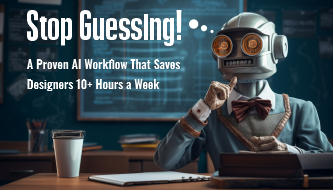
Stop Guessing: A Proven AI Workflow That Saves Designers 10+ Hours a Week

A Proven AI Workflow That Saves Designers 10+ Hours a Week

The Real Problem Isn’t AI — It’s Guessing


The Real Problem Isn’t AI — It’s Guessing
Save
Handsome caucasian man with beard holding brain and question mark skeptic and nervous, frowning upset because of problem. negative person.

Let’s be honest.

Most designers today are not struggling because of AI.
They’re struggling because of unclear workflows.

  • Too many tools
  • Too many options
  • Too many directions

So what happens?

👉 You guess.
👉 You try random prompts.
👉 You restart projects.
👉 You waste hours.

The result? Slower work, inconsistent quality, and frustration.

The good news:
Top designers are already using a proven AI workflow that removes guesswork and saves 10+ hours per week.

This guide shows you exactly how it works.

You May Also Like:


Why Designers Waste So Much Time (Without Realizing It)

Before fixing the problem, let’s identify it.

Most time is lost in:

❌ Starting without clarity

Jumping into tools without a defined idea

❌ Endless iterations

Trying random variations without direction

❌ Tool switching

Using multiple tools without a system

❌ Reworking designs

Fixing mistakes that could have been avoided earlier

This isn’t a skill issue.
It’s a workflow issue.

What Makes This AI Workflow Different

This workflow is built around one principle:

👉 Clarity first, AI second

Instead of using AI to guess, you use it to:

  • explore intentionally
  • validate ideas
  • accelerate execution

It turns AI from a random generator into a structured design system.

The Proven AI Workflow (Step-by-Step)

Here’s the exact structure modern designers use in 2026.

The Proven AI Workflow (Step-by-Step) Here’s the exact structure modern designers use
Save
Programmer developing software on a large computer screen

Step 1 — Define Before You Design

Before touching any tool, define:

  • What is the goal of this design?
  • Who is the audience?
  • What problem are you solving?
  • What outcome do you want?

This step alone can save hours.

💡 Tip:
Write a 3-line brief. That’s enough.

Step 2 — Generate Multiple Directions (Not One)

Now use AI for exploration.

Instead of searching for the “perfect” design, generate:

  • 5–10 visual directions
  • different styles
  • layout variations
  • moodboards

This avoids the biggest trap:
👉 falling in love with the first idea.

Step 3 — Curate and Combine

This is where designers create value.

Don’t pick one output.
Instead:

  • combine the best elements
  • remove generic AI artifacts
  • refine the visual direction

Think like an art director, not a user.

Step 4 — Build in Real Design Tools

Move into your main tools:

  • Figma
  • Adobe
  • Webflow

Now:

  • refine layout
  • fix hierarchy
  • improve usability
  • apply brand rules

AI gives direction.
You create the final product.

Step 5 — Use AI for Feedback

This is the step most designers skip.

Ask AI:

  • What’s unclear in this design?
  • What could confuse users?
  • How can this be improved?

This acts like a second designer reviewing your work.

Step 6 — Final Optimization

Before delivery:

  • check consistency
  • refine spacing
  • validate typography
  • ensure clarity

This is where good design becomes great.

How This Workflow Saves 10+ Hours a Week

Here’s where the real value appears.

⏱ Faster decision-making

No more random exploration

🎯 Better direction early

Less rework later

🔁 Fewer iterations

More intentional changes

⚡ Reduced mental fatigue

Clear process = less stress

Time saved doesn’t come from speed.
It comes from clarity.

Real Example: Before vs After

Before:

  • 3–4 hours exploring ideas
  • multiple redesigns
  • unclear direction

After:

  • 30–60 minutes structured exploration
  • clear concept early
  • minimal rework

That’s where the 10+ hours per week comes from.

Common Mistakes That Kill Productivity

Even with AI, these mistakes slow designers down:

❌ Using AI without structure

Leads to chaos

❌ Trusting first results

Leads to average design

❌ Ignoring brand consistency

Creates inconsistent work

❌ Overusing AI visuals

Makes designs look generic

Why This Matters in 2026

Design is no longer just about creativity.

Clients expect:

  • faster turnaround
  • multiple concepts
  • strategic thinking
  • measurable results

Designers who work without a system fall behind.
Designers with workflows stand out.

Key Takeaways

  • Guessing is the biggest productivity killer
  • AI works best with clear direction
  • Structure saves more time than speed
  • Curation is your strongest skill
  • The best designers use systems, not shortcuts

Conclusion: Stop Guessing, Start Designing

AI is powerful — but only if you use it правильно.

If you remove guessing and follow a structured workflow, you’ll:

  • work faster
  • design better
  • feel more confident in your decisions

The future of design isn’t about working harder.
It’s about working smarter with AI.


Discover more from DesignRise

Subscribe to get the latest posts sent to your email.

Leave a Reply

Your email address will not be published. Required fields are marked *

Discover more from DesignRise

Subscribe now to keep reading and get access to the full archive.

Continue reading